




Key Takeaways
- A cryogenic deflashing line holding a pass rate above 98% scraps less than 2% of every 15-20 kg batch – yield is the largest eco lever, ahead of any kWh saving.
- An air-power deflashing machine processes about 4 kg per minute with zero liquid nitrogen, fully eliminating cryogen for molded parts of 3-80 mm outer diameter.
- A 600 L roller oven with 100 mm insulation keeps its outer wall at or below 35 C while running up to 280 C inside, containing heat instead of leaking it.
- A full clean-and-dry cycle consumes about 2.5 kWh and roughly 0.1 t of water per 6-minute wash – both numbers are measurable per-batch benchmarks you can audit.
Sustainability questions arrive on B2B rubber lines in a predictable way: a customer questionnaire, an audit against ISO 14001, or a corporate target that asks your plant for numbers rather than intentions. We have watched factories respond with signage and recycling bins, and we have watched others respond with equipment. The second group is the one whose numbers actually move.
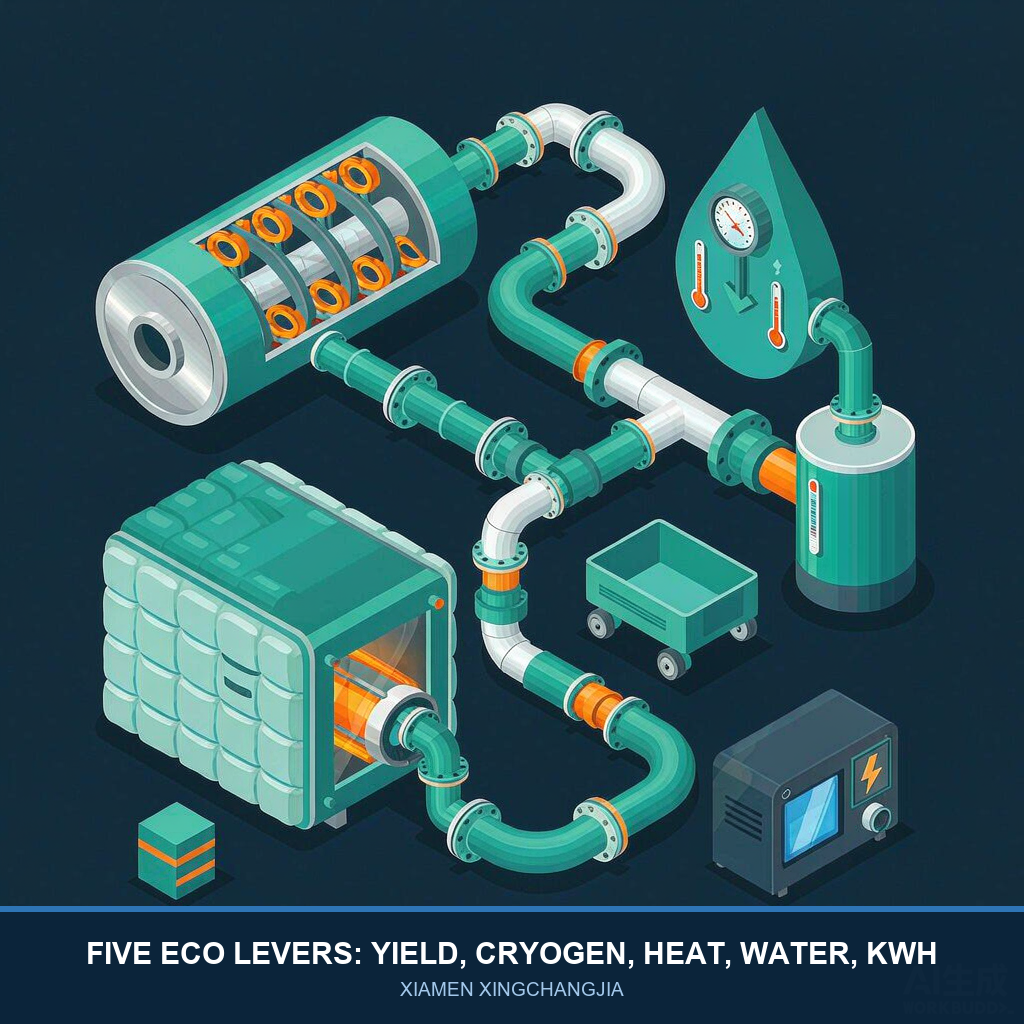
This guide translates “eco-friendly” into five equipment-level levers with verifiable specifications, so you can evaluate machines the way an auditor would – in kilograms saved, kilowatt-hours avoided and liters not consumed.
What Does Sustainable Rubber Processing Mean in Practice?
In practice, sustainable rubber processing means minimizing the resources consumed per finished kilogram of accepted parts – material, energy, water and media combined. It is a per-unit metric, not a company slogan. Every scrapped O-ring carries the full footprint of its compounding, mixing and molding history, so yield beats every other environmental metric on the line. A part you throw away costs as much energy as a part you ship, and returns nothing for it.
Because that framing is measurable, it converts directly into a shortlist of equipment decisions:
| Eco Lever | Equipment Decision | Measurable Effect |
|---|---|---|
| Material yield | Cryogenic deflashing, 80 L drum | >98% pass rate on 15-20 kg batches |
| Cryogen elimination | Air-power deflashing for OD 3-80 mm | 0 L of liquid nitrogen per kg processed |
| Heat containment | Roller oven, 100 mm insulation | Outer wall ≤ 35 °C at up to 280 °C inside |
| Water metering | Cleaning-drying machine, metered spray | 20 L/min; ≈ 0.1 t per 6-minute wash |
| Electricity per cycle | Clean-and-dry in one machine | ≈ 2.5 kWh per 20-minute cycle |
Machine values from official product pages of Xingchangjia; see the rubber deflashing machine category for the full range.
Which Deflashing Method Wastes the Least Material?
The lowest-waste method is the one sized to your part geometry. For precision parts with thin flash, cryogenic deflashing embrittles the flash in under 8 minutes per cycle at -150 C and holds the finished pass rate above 98%. Because the flash on precision rubber parts is thinner than on ordinary products, it embrittles faster than the part body does – so the machine removes flash without touching the surface underneath, and a 15-20 kg batch in the 80 L drum ends with less than 2% of its mass in the scrap bin.
For molded rubber parts of 3-80 mm outer diameter, the eco calculation is even simpler: skip the cryogen entirely. Our air-power rubber deflashing machine removes edges on aerodynamic principles alone – no freezing, no liquid nitrogen, no consumable cryogen logistics – at about 4 kg per minute, which equals the output of 40-50 manual operators. Replacing manual trimming with one air-power unit removes an entire consumable from your bill of materials while multiplying throughput roughly 40-fold. Its dual spray system meters water for silicone parts and silicone oil for rubber parts only when needed, and the 999-recipe memory means changeovers rerun proven parameters instead of trial-and-error scrap.
Between those two sits the mechanical XCJ-G600 super model: a 600 mm drum that trims a 15 kg batch of O-rings in 20-40 seconds on a 7.5 kW inverter drive. Because one G600 does the work of three conventional machines, it concentrates the same output into one motor, one footprint and one cable run.
Why Does Thermal Equipment Design Decide Your Energy Bill?
Secondary vulcanization is where heat – and money – leaks. A well-built roller oven for secondary vulcanization attacks that loss with three design choices: 100 mm of insulation that keeps the outer wall at or below 35 C even at 280 C inside, a PID controller driving solid-state relays so heaters ramp smoothly instead of start-stopping, and a 0-99.99 h timer that cuts heat automatically when the cycle ends. Insulation is the quietest eco component on any rubber line, because every watt it contains is a watt the 10.5 kW heater never has to re-earn.
The control logic matters as much as the insulation. Frequent heater start-stop cycles both waste energy and stress elements; continuous 4-20 mA PID control through SSRs avoids that, which is why plants running ISO 50001 energy management programs look for exactly this spec. The 600 L octagonal drum tumbles parts through a 3000 m³/h airflow so every part sees the same heat, cutting the reruns that burned energy for nothing.
How Much Water Does Cleaning Really Use?
Cleaning is the most commonly ignored eco number because water rarely appears on a machine quote. On the XCJ-QXJ 600 cleaning and drying machine it is explicit: high-pressure spray at 20 L per minute, roughly 0.1 t per single 6-minute wash, for drum loads of 15-30 kg in a 600 mm by 1000 mm stainless drum. Knowing your liters-per-batch number is what turns water from an invisible utility line into a managed process variable.
The machine’s air pre-drying stage is the second half of the story: blowing ambient air first strips most surface moisture mechanically, so the ceramic heater and multi-wing centrifugal fan finish the job on a much shorter duty cycle. A complete clean-and-dry run consumes about 2.5 kWh in roughly 20 minutes – and as typical values from our experience, pairing the first rinse of the next batch with the final rinse water of the previous one cuts cleaning water demand by around 30% on multi-batch days.
Ask for the per-batch numbers before you buy
Request three figures from any equipment supplier: kWh per cycle, liters of water per batch, and yield percentage. Machines specified to those benchmarks – like the 2.5 kWh clean-and-dry cycle above – let you audit sustainability the same way you audit quality.
How to Run a 5-Step Eco Audit of Your Equipment Line?
- Measure your baseline per finished kilogram. Total kWh, liters of water and kilograms of scrap across one representative week, divided by the kilograms of accepted parts shipped – that single ratio is your audit anchor.
- Map each number to a machine. Assign every kWh and liter to a specific station – deflashing, curing, cleaning – so improvement effort lands where the consumption physically happens.
- Rank the levers by footprint, not by habit. If scrap exceeds 2%, yield work comes first; if ovens dominate kWh, insulation and control upgrades come first; if cleaning dominates water, spray metering and rinse reuse come first.
- Eliminate consumables where geometry allows. Parts of 3-80 mm outer diameter with conventional molded flash are candidates for air-power deflashing, removing liquid nitrogen from the line entirely.
- Specify longevity at purchase. Thickened 304 stainless construction, overtemperature protection and corrosion-resistant wetted parts extend machine life – the greenest machine is the one you do not replace.
Because audits surface the same failure patterns repeatedly, this diagnostic table covers the four we see most:
| Symptom | Likely Cause | Equipment Fix |
|---|---|---|
| kWh per kg drifting upward | Aged insulation, leaking door seals, start-stop heater control | Re-insulate or move to PID-SSR oven control |
| Scrap rate above 5% | Deflashing method mismatched to part geometry | Re-route parts between cryogenic, air-power and drum methods |
| Water bill climbing | Single-pass rinsing with no reuse stage | Add metered spray and final-rinse recovery |
| LN2 costs volatile | Freezing parts that do not need cryogen | Qualify parts of 3-80 mm OD for air-power deflashing |
Symptom-cause pairs are typical values from our experience across customer lines.
Conclusion: Sustainability Is a Specification, Not a Slogan
Eco-friendly equipment choices in rubber processing come down to five verifiable numbers: yield above 98%, zero cryogen where geometry permits, an oven wall at or below 35 C, water metered at 20 L per minute, and electricity counted per cycle. Because each number is fixed by the machine on your floor, sustainability audits become straightforward equipment reviews. Plants that buy against those specifications hit their environmental targets without a single retrofit program.
Review your line against the five levers above, then talk to our engineering team about which stations move your numbers first – www.xmxcjrubber.com.
Related Equipment Information
• Air-power rubber deflashing machine – zero-nitrogen edge removal at about 4 kg/min for parts of 3-80 mm OD.
• Liquid nitrogen cryogenic deflashing machine – 80 L drum, -150 C, cycles under 8 minutes, pass rate above 98%.
• Roller oven for secondary vulcanization – 100 mm insulation, outer wall at or below 35 C, 10.5 kW heater with PID-SSR control.
• Rubber cleaning and drying machine – metered 20 L/min spray, about 2.5 kWh per clean-and-dry cycle.
Frequently Asked Questions: Sustainable Rubber Processing
Is sustainable rubber processing mainly about recycling scrap rubber?
Does choosing eco-friendly equipment reduce productivity?
How much liquid nitrogen does cryogenic deflashing actually use?
What is the highest-ROI eco upgrade on an existing rubber line?
Why does 304 stainless steel construction matter for sustainability?
How should I evaluate a supplier’s eco-friendly claims?
Xiamen Xingchangjia Non-Standard Automation Equipment Co., Ltd.
Floor1, Building 13, Huli Industrial Park, Meixidao, Tongan, Xiamen China
Email: info@xcjrubber.com | Website: www.xmxcjrubber.com
Published: November 2026 | Last verified: November 2026
Post time: Nov-03-2026