




Key Takeaways
- Electricity is minor: a 7.5 kW motor on a 75-second cycle draws about 0.16 kWh, or 0.01 kWh per kg of rubber.
- Labour and handling take 45-60% of mechanical running cost, while liquid nitrogen takes 55-70% of cryogenic running cost.
- Typical cost per 1,000 two-gram O-rings runs from 23-36 USD by hand down to 1.8-3.0 USD on a mechanical deflashing machine.
- Budget 4-7% of purchase price per year for spares, and expect total operating cost near 6-10% of purchase price annually.
The short answer: running a rubber deflashing machine costs roughly 1.80 to 4.20 USD per 1,000 small O-rings, and electricity is under 3% of that figure. Labour, handling, blasting media or liquid nitrogen and yield loss make up more than 80% of the bill, so the machine with the lowest kW rating is rarely the cheapest one to own.
Most quotations compare machines on purchase price and motor power. Neither number tells you what a finished part costs, and that is the number your customer negotiates against.
This breakdown converts published specifications from three of our machines into cost per 1,000 parts, then shows where each dollar actually lands.
What Are the Five Cost Buckets in a Deflashing Operation?
Every deflashing operation carries exactly five recurring cost buckets, and they behave differently: two scale with parts, two scale with time, one scales with mistakes. Separating them is the whole exercise, because a single blended hourly rate hides which lever to pull.
| Cost bucket | Typical share | What drives it |
|---|---|---|
| Labour and handling | 45-60% mechanical / 15-25% cryogenic | Parts per load, attention per cycle, inspection time |
| Media or liquid nitrogen | 0-5% mechanical / 55-70% cryogenic | kg of nitrogen per kg of rubber, hold time |
| Spare parts | 8-15% | Impeller or blade wear, door seals, filters |
| Energy | 2-4% | Motor kW multiplied by cycle seconds |
| Yield loss and rework | 5-20% | Over-trim, part damage, mixed sizes in one load |
Share ranges are typical values from our experience across customer installations in seals, automotive and electronics.
How Much Does Electricity Really Cost per Kilogram?
The XCJ-G600 mechanical deflashing machine drives a 7.5 kW motor through an inverter and quotes 20-40 s of trimming for a load of roughly 15 kg. Add 30 s for loading, unloading and blow-off and one cycle is about 75 s, so the motor draws roughly 0.16 kWh per batch at full load — about 0.01 kWh per kg of rubber.
At 0.10 USD per kWh that is 0.016 USD per 15 kg batch, or roughly 0.001 USD per kg; the U.S. Energy Information Administration publishes monthly tariff benchmarks if you need a defensible local figure. Because the inverter only ramps the motor during the trim phase, real consumption usually lands 40-60% below that full-load figure (typical values from our experience). The electricity meter is not where the money goes.
Why Does Liquid Nitrogen Dominate a Cryogenic Line?
The 80 L liquid nitrogen cryogenic deflashing machine holds 15-20 kg per roller load, reaches -150 °C and completes a cycle in under 8 minutes, yet its rated refrigerating capacity is only 1.1 kW. Electricity therefore costs about 0.015 USD per cycle, while the nitrogen that makes the cycle possible costs 7-13 USD.
Between 0.8 and 1.2 kg of liquid nitrogen is consumed per kg of rubber on a well-tuned machine (typical values from our experience), so an 18 kg load of small seals needs 15-22 kg of nitrogen. Delivered nitrogen at 0.45-0.70 USD per kg puts media alone at 0.36-0.84 USD per kg of finished parts.
| Nitrogen used (kg per kg of parts) | At 0.45 USD/kg | At 0.65 USD/kg |
|---|---|---|
| 0.8 | 0.36 USD/kg | 0.52 USD/kg |
| 1.0 | 0.45 USD/kg | 0.65 USD/kg |
| 1.2 | 0.54 USD/kg | 0.78 USD/kg |
Media cost only. Labour, spares and electricity are additional.
Because nitrogen is the dominant line item, cryogenic cost control is a logistics problem rather than a machine problem. Tank size, refill frequency and how tightly the roller is packed move the number more than any setting on the touch screen.
What Does Labour Really Cost per 1,000 Parts?
Labour should be counted per load, not per machine-hour. One operator loading, unloading and eyeballing a 15 kg batch of 2 g O-rings handles about 7,500 parts and spends 60-90 s of real attention per cycle. If that operator tends three mechanical machines at 9 USD per hour fully loaded, labour content lands near 0.70-1.00 USD per 1,000 parts.
Hand deflashing the same 7,500 parts takes 19-30 operator-hours at 250-400 parts per hour, which is 23-36 USD per 1,000 parts. That gap, not the energy bill, is what pays for the machine. Guarding matters here too: because machine guarding rules require door interlocks, a machine without them cannot be left to run unattended, which quietly pushes labour cost back up.
Which Costs Only Show Up After Twelve Months?
Wear parts and rejects are invisible in a first-month trial. Door seals on a cryogenic unit typically last 6-12 months, blasting impellers or blade sets 12-24 months, and vacuum filters a quarter. Because these items fail gradually, output stays flat while cost per part climbs — the classic sign that a machine is quietly out of specification.
| Cost symptom | Likely cause | Action |
|---|---|---|
| Cost per 1,000 parts creeping up | Worn impeller or media, longer cycle needed to clear flash | Replace wear parts on a shift-count schedule |
| Nitrogen bill rising at constant output | Poor load density, leaking door seal, excessive hold time | Fill the roller to 80-90% of usable volume |
| Reject rate above 2% | Over-trim on thin flash, mixed part sizes in one load | Split loads by size and shorten the cycle |
Diagnostic order that resolves most cost drifts we see in service calls.
Step by Step: Build a Cost-per-1,000-Parts Number You Can Defend
- Fix the unit and the part. Weigh ten finished parts, divide the load weight by that figure, and record parts per batch so every later number shares one denominator.
- Meter one full shift. Log kWh from a clamp meter, nitrogen kg from tank weight difference, operator hours and rejects. One shift of honest data beats a month of estimates.
- Allocate each cost by its driver. Media, spares driven by parts and inspection labour go per 1,000 parts; standing energy, operator attendance and floor space go per hour, then divide by throughput.
- Add the annualised spares line. Divide last year’s spare-parts spend by last year’s part count instead of guessing a percentage.
- Re-run it every quarter. A costing model that is never refreshed will keep justifying a machine that has already drifted out of tolerance.
How Do the Four Methods Compare per 1,000 Parts?
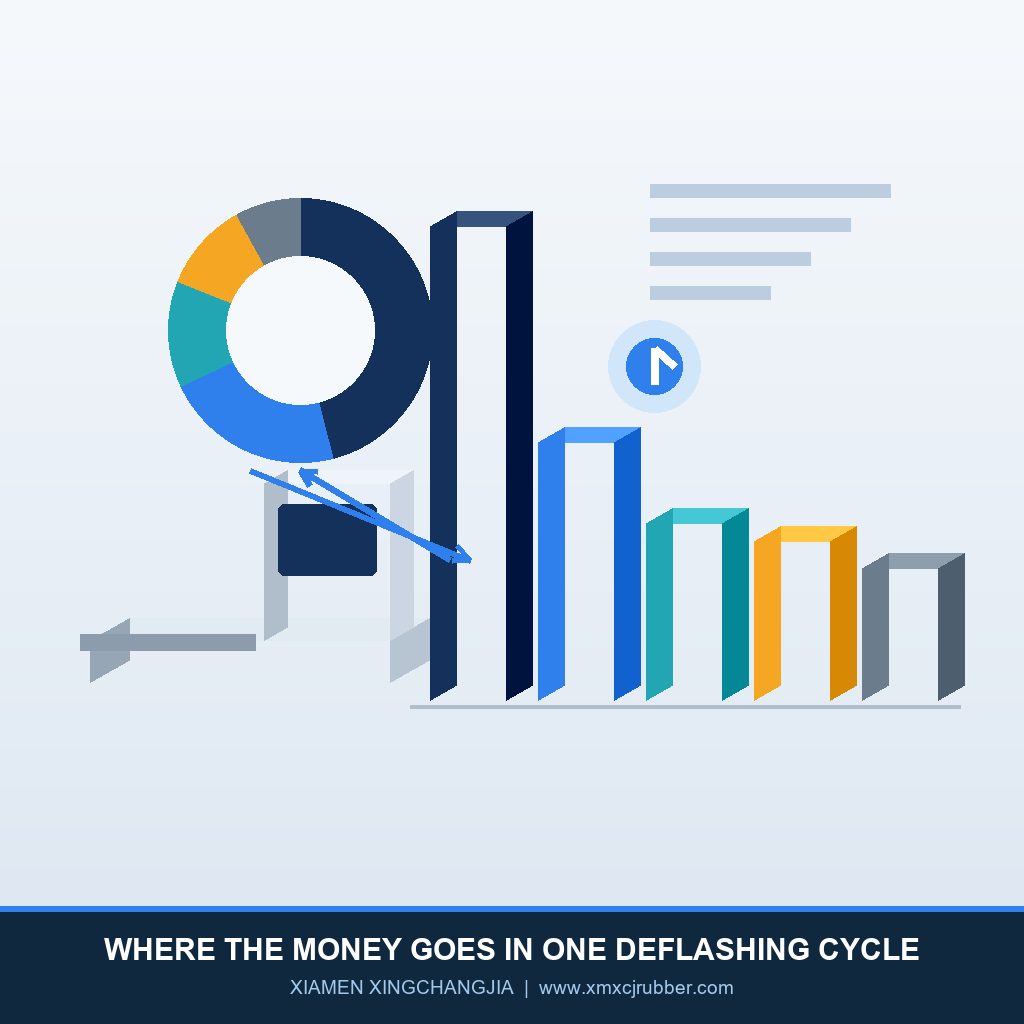
For small O-rings, mechanical deflashing is the cheapest method per part, air-power sits in the middle, and cryogenic wins only when flash is too thin or too fine for mechanical media to reach.
| Method | Cycle or throughput | Main cost driver | Cost per 1,000 parts |
|---|---|---|---|
| Hand deflashing | 250-400 parts/h per operator | Labour | 23-36 USD |
| Air-power deflashing | Up to 4 kg/min, OD 3-80 mm | Labour, water and silicone | 3.00-5.50 USD |
| Mechanical XCJ-G600 | 15 kg per 20-40 s trim | Labour and spares | 1.80-3.00 USD |
| Cryogenic liquid nitrogen | 15-20 kg per cycle under 8 min | Liquid nitrogen | 2.60-4.20 USD |
Assumes 9 USD/h fully loaded labour, 0.10 USD/kWh and 0.55 USD/kg nitrogen; typical values from our experience with 2 g O-rings.
How Can You Cut Operating Cost Without Cutting Quality?
Five changes deliver most of the saving, and none of them touches part quality. Pack the barrel or roller to 80-90% of usable volume, because cycle cost is fixed per load and a half-full load doubles cost per part. Store proven recipes in the controller memory — the air-power deflashing machine keeps 999 product programs — so changeovers stop burning first-batch scrap. Screen parts by size before deflashing, tend three machines per operator instead of one, and buy the method that matches your flash thickness rather than the one with the lowest price tag.
Lowest kW does not mean lowest cost
The 1.1 kW cryogenic unit can cost two to eight times more per part than the 7.5 kW mechanical machine on the same O-ring, because nitrogen carries the bill. Compare cost per 1,000 parts, never nameplate power.
Conclusion: Price the Part, Not the Machine
Electricity is noise. Labour, media and yield loss decide whether a deflashing line is profitable, and they behave very differently on mechanical, air-power and cryogenic equipment. Model cost per 1,000 of your own parts before you sign, then re-measure after the first quarter.
Send us your part drawing, flash thickness and monthly volume, and we will return a cost-per-1,000-parts estimate built on the specifications of the machines we would actually quote.
Related Equipment Information
• Rubber deflashing machine range — mechanical, air-power and cryogenic models in one place.
• XCJ-G600 super model deflashing machine — 600 mm barrel, 7.5 kW inverter drive, 15 kg batches.
• Liquid nitrogen cryogenic deflashing machine — 80 L roller, -150 °C, under 8 minutes per cycle.
• Rubber separator machines — recover good parts from flash before it becomes scrap.
Frequently Asked Questions: Deflashing Running Costs
Xiamen Xingchangjia Non-Standard Automation Equipment Co., Ltd.
Floor1, Building 13, Huli Industrial Park, Meixidao, Tongan, Xiamen China
Email: info@xcjrubber.com | Website: www.xmxcjrubber.com
Published: October 2026 | Last verified: October 2026
Post time: Oct-20-2026