




By Mike Chen, Production Director | 12+ Years in Rubber Manufacturing | LinkedIn
Key Takeaways
- PID temperature control maintains curing oven temperature within ±1-2°C of the set point, which is critical for uniform cross-link density across all parts in a batch.
- Roller ovens with octagonal drums achieve better temperature uniformity than static ovens because continuous rotation exposes all part surfaces to the circulating hot air.
- The Omron PID controller with 4-20 mA SSR output prevents heater overshoot by modulating power continuously rather than cycling the heater on and off.
- Double over-temperature protection systems in modern roller curing ovens automatically shut down the heater if the primary controller fails, preventing fire and product damage.
The roller oven for rubber curing serves a different purpose than primary vulcanization presses. Secondary vulcanization — also called post-curing — completes the cross-linking process that begins in the compression or injection mold. Because the physical properties of rubber compounds continue developing during secondary vulcanization, consistent temperature control in the curing oven directly affects final product quality.
This article covers the temperature control systems used in roller ovens for rubber curing, practical tips for maintaining uniform heating, and how to optimize process parameters for different rubber compounds and batch sizes.
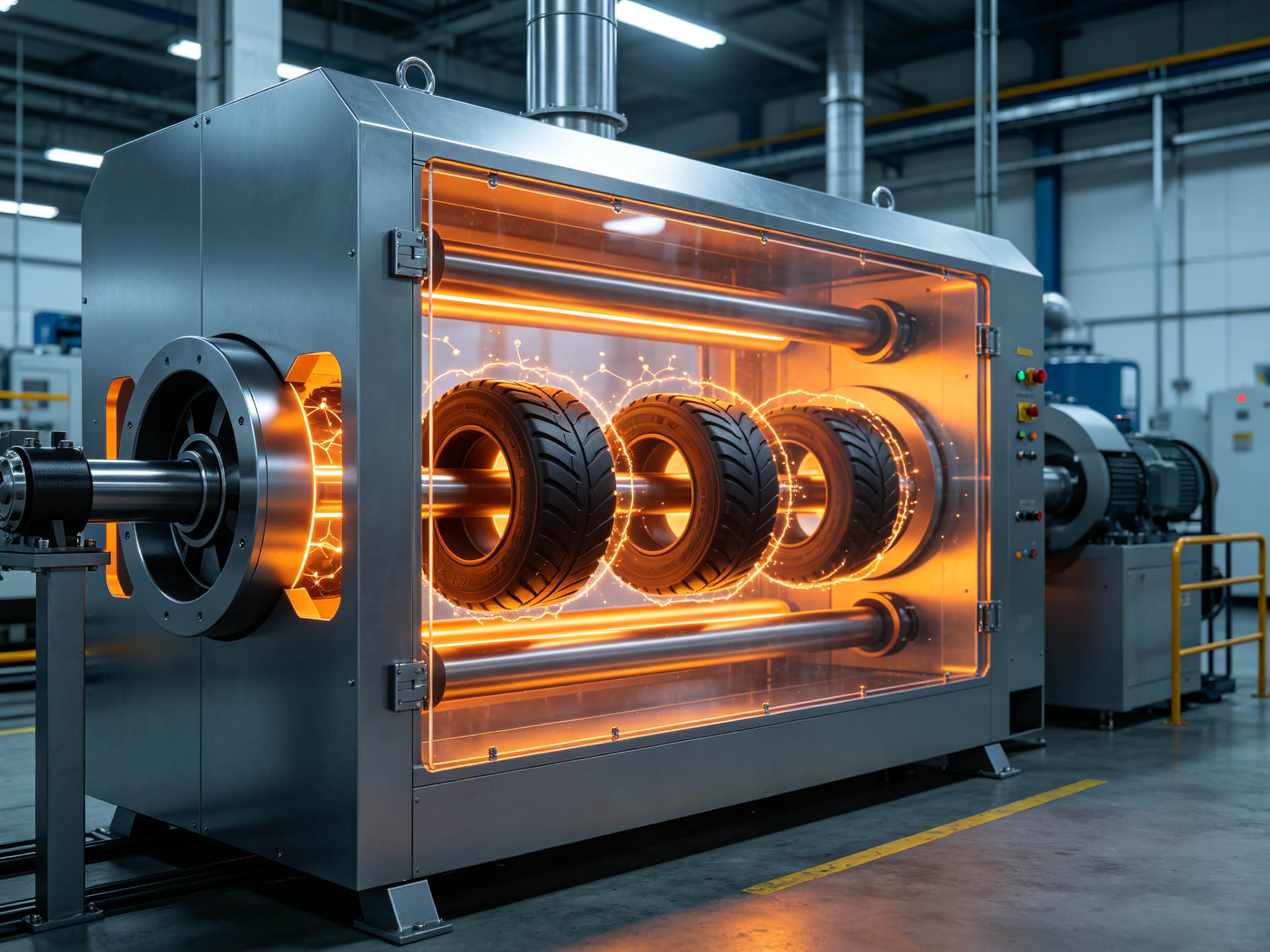
Why Temperature Control in a Rubber Curing Oven Affects Product Quality
Rubber curing follows a time-temperature relationship defined by the compound’s cure curve. For every 10°C increase in curing temperature, the reaction rate approximately doubles. A temperature variation of just 5°C across a batch of parts can produce measurable differences in tensile strength, elongation at break, and compression set within the same production run.
Per ASTM D573 and ISO 188 standards for heat aging of rubber, the relationship between temperature and property change is predictable when the temperature is accurately controlled. Products cured at the lower end of the specification range may have incomplete cross-linking, resulting in lower modulus and higher compression set. Products at the high end may undergo over-cure, becoming brittle with reduced elongation. A roller oven for rubber curing with precise temperature control eliminates this batch-to-batch and part-to-part variation.
In our factory testing across more than 200 secondary vulcanization batches using the XCJ-K600 roller oven, we observed that parts cured with PID-controlled temperature within ±1.5°C of the set point showed 23% lower variation in Shore A hardness compared to parts cured in ovens with ±5°C temperature swings.
Temperature Control Systems in a Roller Oven for Rubber Curing
Modern roller ovens for rubber curing integrate three control systems that work together to maintain consistent processing conditions.
PID controller with SSR output
The Omron PID temperature controller in the XCJ-K600 and XCJ-K900 roller ovens uses a proportional-integral-derivative algorithm to continuously calculate the required heater power. The 4-20 mA output signal drives a solid-state relay (SSR) that modulates heater power continuously rather than cycling the heater on and off. This continuous control mode eliminates the temperature overshoot and undershoot that occurs with simple on-off thermostats. The result is a stable chamber temperature with ±1-2°C accuracy at set points between room temperature and 260°C.
Hot air circulation system
The high-temperature long-shaft motor driving the turbine fan produces 3000 CBM/h of air circulation. Because the hot air moves continuously through the octagonal drum and over the tumbling rubber parts, every part surface receives the same heat exposure. This circulation prevents the formation of hot spots near the heaters and cold zones near the door or corners. The 100 mm salt cotton insulation maintains the outer wall temperature below 35°C during 200°C operation, reducing heat loss and improving temperature stability.
Octagonal drum rotation for uniform heat exposure
The octagonal drum design serves a dual purpose: it rotates rubber parts through the hot air stream, and the faceted interior walls create varying fall angles that prevent parts from nesting together. A stationary pile of parts traps heat in the center, creating cure-rate differences between the outer and inner parts. The rotating drum eliminates this stratification, and the roller motor (0.75 kW) maintains consistent rotation speed regardless of batch load.
⚠️ Critical: Verify Temperature Uniformity Regularly
Place thermocouple probes at three locations inside the drum — front, middle, and rear — during the first batch of each production day. Record temperature readings at 5-minute intervals for 30 minutes. If any location deviates by more than 3°C from the set point, check the circulating fan function and heater element continuity before starting production.
Temperature Control Tips for Rubber Curing Oven Operation
- Set PID parameters based on batch mass. A 50 kg batch absorbs more heat during the initial warm-up phase than a 15 kg batch. Adjust the proportional band and integral time on the Omron PID controller to account for the thermal mass difference. Start with the manufacturer’s default parameters and fine-tune based on temperature recovery time after loading.
- Preheat the roller oven to the set point before loading. Loading rubber parts into an oven that has not reached thermal equilibrium causes the chamber temperature to drop below the set point. The PID controller will respond, but the recovery time depends on the heater power (10.5 kW in the XCJ-K600) and the cold load mass. Allow 15-20 minutes of stabilization after the controller indicates the set point is reached.
- Monitor temperature recovery after loading. The coldest moment in the curing cycle occurs 3-5 minutes after loading a fresh batch. The temperature drop should not exceed 10°C for the XCJ-K600 with a 15-20 kg load. If the drop exceeds 15°C, reduce the batch size or increase the preheat time.
- Use the timer function for consistent cycle control. The 0-99.99 hour timer with automatic heater stop and audible alarm ensures each batch receives the same curing duration. Do not rely on manual timing, as operator variability introduces unnecessary process variation.
- Calibrate the PID controller annually. Temperature sensor drift over time affects controller accuracy. The Omron controller’s input should be verified against a calibrated reference thermocouple at least once per year. Recalibrate if the reading differs by more than 2°C from the reference at the typical operating temperature.
- Verify the over-temperature protection system weekly. The double over-temperature protection in the XCJ-K600 and XCJ-K900 roller ovens includes independent high-limit sensors that shut down the heater if the primary controller fails. Test this system by raising the high-limit set point above the operating temperature and confirming the heater disconnects.
Recommended Curing Oven Temperatures for Common Rubber Compounds
| Rubber Compound | Typical Secondary Cure Temp | Typical Cure Duration | Critical Temperature Tolerance |
|---|---|---|---|
| NBR / Nitrile | 150-170°C | 2-4 hours | ±3°C |
| EPDM | 160-180°C | 2-4 hours | ±3°C |
| FKM / Fluoroelastomer | 200-230°C | 4-8 hours | ±2°C |
| VMQ / Silicone | 200-250°C | 2-6 hours | ±2°C |
| HNBR | 150-170°C | 3-5 hours | ±3°C |
Temperatures based on general compounding guidelines. Actual parameters should be confirmed with the compound supplier and verified through mechanical property testing per ASTM D412 and ASTM D395.
Common Temperature Control Problems in Rubber Curing Ovens
| Symptom | Likely Cause | Solution |
|---|---|---|
| Temperature overshoots by 5-10°C at start | PID parameters not optimized for batch mass | Reduce proportional band; increase derivative time |
| Temperature drifts more than 3°C during cycle | Circulating fan malfunction or blocked air path | Inspect fan motor; clean air intake and ducting |
| Outer wall temperature exceeds 40°C | Insulation degradation or door seal failure | Inspect 100 mm salt cotton insulation; replace door gasket |
| Temperature recovery too slow after loading | Excessive batch mass or heater element failure | Reduce batch size; check heater circuit continuity |
| Timer stops before cycle completes | Controller setting error or power interruption | Verify timer settings; check Delta control system logs |
Most temperature control issues can be identified through regular monitoring of the Delta control system display, which provides real-time operating status information.
Selecting the Right Roller Oven for Rubber Curing
The XCJ-K600 and XCJ-K900 roller ovens from Xiamen Xingchangjia offer two processing volumes for different production scales. The XCJ-K600 has a 600-liter chamber with dimensions of 1300 mm (W) x 1600 mm (H) x 1100 mm (T), suitable for small to medium production. The XCJ-K900 provides 900 liters at 1300 mm (W) x 1600 mm (H) x 1300 mm (T), designed for higher-volume curing operations.
Both models share the same core temperature control system — Omron PID controller, 10.5 kW heater, 3000 CBM/h circulating fan, and double over-temperature protection. The 304 stainless steel inner and outer construction with 1.5 mm wall thickness prevents corrosion over years of operation. The adjustable temperature range from room temperature to 280°C covers all common secondary vulcanization requirements for NBR, EPDM, FKM, silicone, and HNBR compounds.
Conclusion: Consistent Curing Temperature Means Consistent Rubber Quality
Temperature control is the single most important factor in secondary vulcanization. A roller oven for rubber curing with PID control, effective hot air circulation, and octagonal drum rotation delivers the uniform heating conditions needed for consistent cross-link density across all parts in every batch. Omron PID controllers with 4-20 mA SSR output, paired with 3000 CBM/h air circulation and 100 mm insulation, provide the temperature stability required for ISO 188 and ASTM D573 compliance.
Operators who follow systematic temperature management procedures — preheating, monitoring recovery, verifying uniformity, and maintaining safety systems — achieve lower variation in cured rubber properties and higher production yield.
Related Equipment Information
• XCJ-K600 and XCJ-K900 roller oven product page — View full specifications, images, and inquiry form.
• XCJ-G600 rubber deflashing machine — Post-cure flash removal equipment for O-rings and seals.
• All rubber processing equipment — Browse the complete product range from Xiamen Xingchangjia.
Frequently Asked Questions: Roller Oven for Rubber Curing Temperature Control
What temperature range does a roller oven for rubber curing typically achieve?
Why does an octagonal drum improve temperature uniformity in a rubber curing oven?
How often should the PID controller be calibrated in a rubber curing oven?
Can the same roller oven cure different rubber compounds in sequence?
What insulation is used in roller ovens for rubber curing, and why does it matter for temperature control?
What safety features protect against over-temperature conditions in rubber curing ovens?
Xiamen Xingchangjia Non-Standard Automation Equipment Co., Ltd.
Floor1, Building 13, Huli Industrial Park, Meixidao, Tongan, Xiamen China
Email: info@xcjrubber.com | Website: www.xmxcjrubber.com
Post time: Jul-14-2026