




Key Takeaways
- The real gap is repeatability, not chemistry: goods-in spread is 8-12 Mooney units for natural rubber versus 3-5 MU for SBR, NBR or EPDM from one supplier.
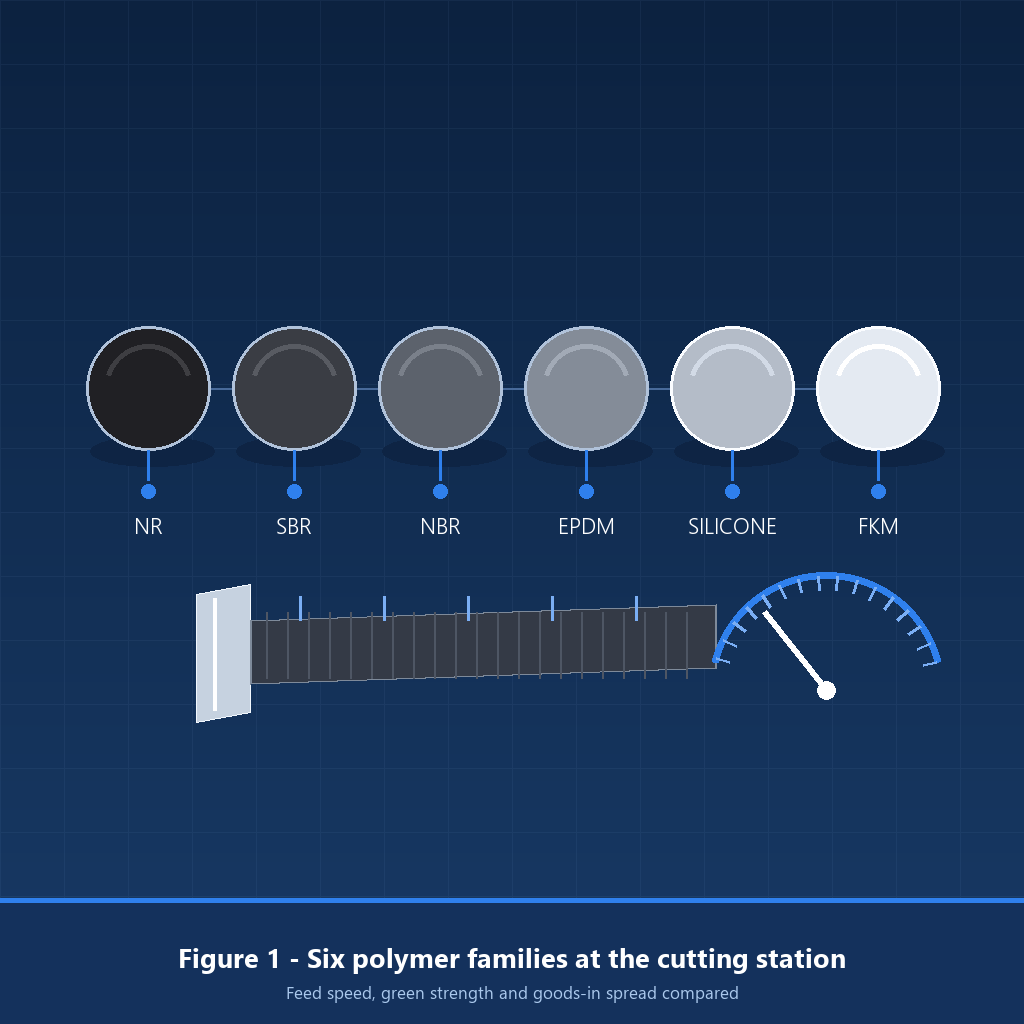
- Green strength moves your cutting setup by 10-30 percent of feed speed at the same 0.5 mm gauge, with silicone at the slow end.
- Cryogenic deflashing at -150 degrees Celsius covers every common polymer because glass transitions run only from -125 degrees to -20 degrees, but soft silicone flash comes off with air power alone.
- Silicone and FKM normally need a 200-250 degrees Celsius post-cure of 4-24 hours; natural rubber is usually finished after press cure.
The short answer: natural rubber and synthetic rubber differ in processing at four stations that cost money: batch consistency at goods-in, green strength at the cutter, flash failure mode at the deflashing unit, and whether the part needs a secondary cure. Natural rubber spreads 8-12 Mooney units between lots but holds its shape well, so cutting tolerances can run wider. SBR, NBR, EPDM, FKM and silicone arrive more uniform but carry lower green strength and often need a 200-250 degrees Celsius post-cure that NR never asks for.
A production line does not lose money in the chemistry lab. It loses money when a strip stretches under the feed roller, when flash tears instead of breaking, or when a batch cures 15 percent faster than the last one. This guide follows the part from goods-in to packing and marks only the differences that force a setting to change.
What Actually Differs Between Natural and Synthetic Rubber in Production?
The difference that reaches the shop floor is repeatability, not molecular structure. Natural rubber is cis-1,4-polyisoprene tapped from Hevea trees and graded by dirt, ash and volatile content. Because it is not formulated to a target, you get whatever the season produced. Synthetic rubber, classified under ISO 1629 by family, is polymerised to a specification.
Because one input is graded and the other is specified, NR shifts your settings and synthetic rubber shifts your excuses. That single asymmetry explains every practical difference below.
Why Does Batch Consistency Decide Your Cutting Tolerance?
Because every cutting parameter you dial in is really a viscosity assumption. A CNC rubber strip cutting machine holds plus or minus 0.1 mm of feed accuracy and shears 0-20 mm thickness at up to 80 strokes per minute, but only while the compound entering the blade has the stiffness the recipe assumed.
Natural rubber must be masticated before mixing, so it reaches you carrying shear history that differs lot to lot. Across customer goods-in records, NR lots commonly spread 8-12 Mooney units (ML 1+4 at 100 degrees Celsius) while SBR, NBR and EPDM lots spread 3-5 MU — typical values from our experience.
An 8-12 MU spread is roughly a 15-20 percent swing in compound stiffness, enough to change how a strip feeds, how far it springs back after the blade, and whether the cut face is square or torn.
| Polymer family | Goods-in spread | Green strength | Feed speed vs NR | Watch point at the cutter |
|---|---|---|---|---|
| NR (SMR 20 / CV grades) | 8-12 MU | High | Baseline | Tacky; strip self-adheres on the reel |
| SBR | 3-5 MU | Medium | +10% | Cleaner cut face, less spring-back |
| NBR | 3-5 MU | Medium-low | +10 to 15% | Harder compound; blade heat builds |
| EPDM | 3-5 MU | Low | +15 to 20% | Stretches under feed; support the strip |
| Silicone | 2-4 MU | Very low | +20 to 30% | Softest; static attracts dust to the face |
| FKM | 2-4 MU | Medium | +15% | Highest scrap cost per rejected metre |
Spread figures are typical values from our experience, not catalogue limits — check them against your own receiving inspection.
Where Do Natural and Synthetic Rubber Split on Flash Removal?
The split is in how the flash fails, not how much of it there is. Natural rubber flash is elastic and tears into strings, SBR and NBR flash crumbles, and silicone flash is weak enough to rub away.
Cold is the universal equaliser. Glass transitions run from about -125 degrees Celsius for silicone to -20 degrees Celsius for FKM, so a liquid nitrogen cryogenic deflashing machine at -150 degrees Celsius puts all of them below the brittle point. Our LN2 unit holds 80 L of roller volume (15-20 kg of small parts) and cycles in under 8 minutes at 20-70 RPM with a pass rate above 98 percent.
Cryo is still not the default. Soft, low-tear-strength flash comes off with a pneumatic air-power deflashing machine at roughly 4 kg/min of media, because you would otherwise pay for liquid nitrogen to do work a half-second air blast already finishes. Run a scrap batch at -80 degrees Celsius first and step down 10 degrees at a time; the warmest setting that still passes your flash specification is the one that saves nitrogen.
Do Synthetic Compounds Need a Second Cure Cycle?
Usually yes, and natural rubber usually no. NR vulcanisation is normally finished inside the press. Silicone and FKM need post-cure to drive off volatiles and complete crosslinking, or hardness and compression set keep drifting after the parts are boxed.
The right tool is a roller oven for secondary vulcanization, not a second press. Our XCJ-K600 (600 L) and XCJ-K900 (900 L) units run from room temperature to 280 degrees Celsius on a 10.5 kW heater, move 3,000 CBM/H of air through an octagonal drum so every surface sees the same temperature, and accept any cure time from 0 to 99.99 hours.
Put the post-cure on a recipe card instead of in an operator’s memory. A nominal 4-hour window that drifts to 6 hours changes hardness and compression set, and dual over-temperature protection exists because a runaway post-cure scorches FKM beyond recovery.
How Does Shrinkage Break Your Tolerance Before You Cut Anything?
Shrinkage is where a correctly cut part becomes a wrong part. Cure shrinkage of 1.5-4 percent means the cut length has to be divided by one minus the shrink figure, not set to the drawing dimension. ASTM D2000 sets hardness and tolerance classes but not shrinkage, so the number has to come from your own trial.
At 3 percent shrinkage a 50.0 mm finished gasket needs a 51.5 mm cut. Set 50.0 mm and the part is already 1.5 mm undersize before inspection — a defect the operator cannot see and the customer will not accept.
NR moves 1.5-3 percent and shrinks more across the grain than along it, because chains orient during milling. Silicone and FKM move 2-4 percent and respond more to cure temperature than to time, so the same recipe on a different press can land outside tolerance.
Which Cleaning Route Fits Which Polymer?
Match the wash to what the surface carries, not to what the part is made of. NR parts arrive dusted with talc or soapstone that synthetic parts do not carry, and NR swells in water while silicone does not.
The rubber cleaning and drying machine XCJ-QXJ 600 uses a 304 stainless drum of 600 mm diameter by 1,000 mm length, takes 15-30 kg per load and runs three groups of six stages. It uses 20 L/min of water (0.1 tonnes per 6-minute wash) and 2.5 kWh for a 20-minute clean-and-dry at 12 kW / 380 V, with counter-rotating nozzles that leave no blind spots.
For NR, use the shortest wash that clears the dusting agent, because long immersion swells the part after you have already inspected it. For silicone, the additive stage earns its place: a water-only wash leaves a film that later shows up as a bonding failure on the customer’s line.
How Do You Re-Qualify a Line for a New Compound?
Re-qualify in five steps, and do not skip the first. Most failed material switches fail because no baseline was recorded, so nobody can prove what changed.
- Freeze the incoming spec. Record Mooney viscosity, hardness, specific gravity and lot number for three lots before touching a setting.
- Re-cut the first article at three feed speeds. Keep the slowest that holds tolerance, since extra speed on a low-green-strength compound only buys scrap.
- Find the brittle window on scrap. Start at -80 degrees Celsius and step down 10 degrees until flash breaks instead of tearing.
- Recalculate cut length from measured shrinkage. Measure five parts 24 hours after cure, never on the day, because most shrinkage completes in that window.
- Write the post-cure recipe to the controller. Ramp rate, hold temperature, hold time and cooling rate, all four, not just the set point.
The 24-hour rule
Never release a shrinkage figure measured on the day of cure. Typical values from our experience: NR parts lose another 0.3-0.6 percent of dimension in the first 24 hours, which is more than the cutting tolerance on a small gasket.
Conclusion: Which Material Should You Standardise On?
Standardise on the material your inspection can actually control. A synthetic compound with 3 MU of spread lets you run tighter tolerances and fewer first-article checks, which is worth more than any single physical property. NR earns its place where resilience and tear strength matter more than repeatability — and then you buy tolerance back with slower feed speeds and shorter washes.
Whichever family you run, the settings live in the machine, not in the polymer. Send your compound, gauge and flash specification and we will match a deflashing or cutting setup to it.
Related Equipment Information
• CNC rubber strip cutting machine — 600, 800 and 1,000 mm widths, 0-20 mm thickness, 0.1 mm feed accuracy.
• Liquid nitrogen cryogenic deflashing machine — -150 degrees Celsius, 80 L roller, under 8 minutes per cycle.
• Rubber cutting machine range — strip, slitter, gasket and weight-cutting models in one place.
Frequently Asked Questions: Natural vs Synthetic Rubber Processing
Xiamen Xingchangjia Non-Standard Automation Equipment Co., Ltd.
Floor1, Building 13, Huli Industrial Park, Meixidao, Tongan, Xiamen China
Email: info@xcjrubber.com | Website: www.xmxcjrubber.com
Published: October 2026 | Last verified: October 2026
Post time: Oct-27-2026