




Author: Xiamen Xingchangjia Non-standard Automation Equipment Co., Ltd.
Rubber deflashing, cutting and automation equipment manufacturer | ISO 9001 | Exports to 15+ countries
Key Takeaways
- Seal geometry and flash location decide the equipment train, not the rubber grade — a lip seal and a flat gasket share material but need different stations.
- One gasket cutter covers 10-180mm diameter, 1-20mm wall, 260mm length at 240 cuts/min with accuracy within ±0.05mm on a 3kW single-phase supply.
- Mechanical deflashing clears a 15kg batch in 20-40s at 7.5kW; cryogenic reaches -150°C in under 8 minutes per cycle with more than 98% pass rate but needs 3P 380V and a nitrogen supply.
- An air separator handles 50kg per cycle at 2.2kW with no sieve change, removing the changeover stall that limits vibration separators.
Most seal factories buy equipment one machine at a time, usually after a quality complaint, and end up with single-purpose machines that share no batch size. This guide works the other way: from the seal families you mold, to the station train they require.
Why Does Flash Location Decide the Equipment Train?
Flash is not one defect. On an O-ring it is a thin film on the parting line; on a flat gasket it is an edge bead on the OD and ID; on a lip seal it can sit directly on the sealing lip. Because the flash location is the surface that must later seal, the finishing method becomes a functional decision rather than a cosmetic one. Material choice barely changes that logic — NBR, FKM and EPDM lip seals all fail the same way if the lip edge is nicked during trimming.
| Seal family | Typical flash location | Functional risk if trimmed badly | Station family |
|---|---|---|---|
| O-ring / torus | Parting-line film all round | Leak path at low pressure | Cut + cryogenic deflash + separate |
| Flat gasket | OD and ID edge bead | Bolt-load loss, creep | Cut + mechanical deflash + separate |
| Lip / rotary shaft seal | Lip edge and OD | Scoring on the shaft | Cut + gentle batch deflash |
| V-ring / chevron pack | Nested edge film | Stack height drift | Cut + cryogenic deflash |
| Bonded washer seal | Metal-rubber interface | Bond-line damage | Cut + manual or gentle deflash only |
Station pairings are typical values from our experience; confirm against your own flash-thickness data.
Which Cutting Station Matches Each Seal Family?
Cutting comes first because a cut error is a cross-section error, and cross-section controls how a seal behaves under pressure. For tube and sleeve stock the binding constraint is wall thickness, because it decides which carbide disc you can run. The XCJ-QGJ2-180# rubber gasket cutting machine cuts 10-180mm diameter, up to 260mm length and 1-20mm thickness at 240 cuts per minute on a double axis, holding accuracy within ±0.05mm from servo accuracy of ±0.01mm and lead screw precision of ±0.02mm.
The disc rule is simple and worth memorizing: below 10mm thickness use the ø60 × ø25.4 × 0.35mm carbide disc, and from 10-20mm use ø80 × ø25.4 × 0.65mm. Running a thin disc in thick stock deflects it, and a deflected disc produces a tapered cross-section that no downstream station can correct. Flat gaskets and sheet-based seals instead start at the rubber cutting machine range, where sheet thickness and width set the envelope.
Utility check before you order
The cutting station runs on single-phase AC220V at 3kW/14A and needs 0.5-0.8MPa air at 45L/min, so it usually drops into an existing cell without a supply upgrade. The cryogenic and mechanical deflashing machines do not: both want 3-phase 380V 50Hz.
Mechanical or Cryogenic: Where Is the Threshold?
The threshold is flash thickness against section modulus, not part size alone. Cryogenic deflashing wins wherever the flash is thinner than the part section, because liquid nitrogen at -150°C embrittles the film faster than the body and the film breaks away without touching the sealing surface. Mechanical tumbling wins where the flash is heavier and the geometry is simple, because impact media reach it without cryogenic cost.
| Criterion | Mechanical (XCJ-G600) | Cryogenic (LN2 unit) |
|---|---|---|
| Best flash class | Heavier flash, robust sections | Hairline film, complex shapes |
| Batch size | About 15kg per batch | 80L roller, about 15-20kg |
| Cycle time | 20-40s per batch | Under 8 minutes per cycle |
| Barrel / drum | 600mm diameter and 600mm depth | 20-70RPM drum speed |
| Power | 7.5kW with inverter | 1.1kW rated refrigeration, 3P 380V |
| Footprint | 1750 × 1000 × 1000mm, 650kg | About 10m² with auxiliaries, 200kg |
| Quality outcome | Consistent edge, media wear to monitor | Pass rate above 98% |
Specifications from the XCJ-G600 machine page and the liquid nitrogen cryogenic deflashing page.
The honest boundary: a cryogenic unit needs a nitrogen supply and a 3-phase feed, and it will not fix flash thicker than the part can tolerate being chilled. A mechanical machine at 7.5kW is cheaper per batch on heavy gasket flash, but cannot reach the microfilm on a nested V-ring without risking edges. Shops running both families usually keep one of each rather than compromise.
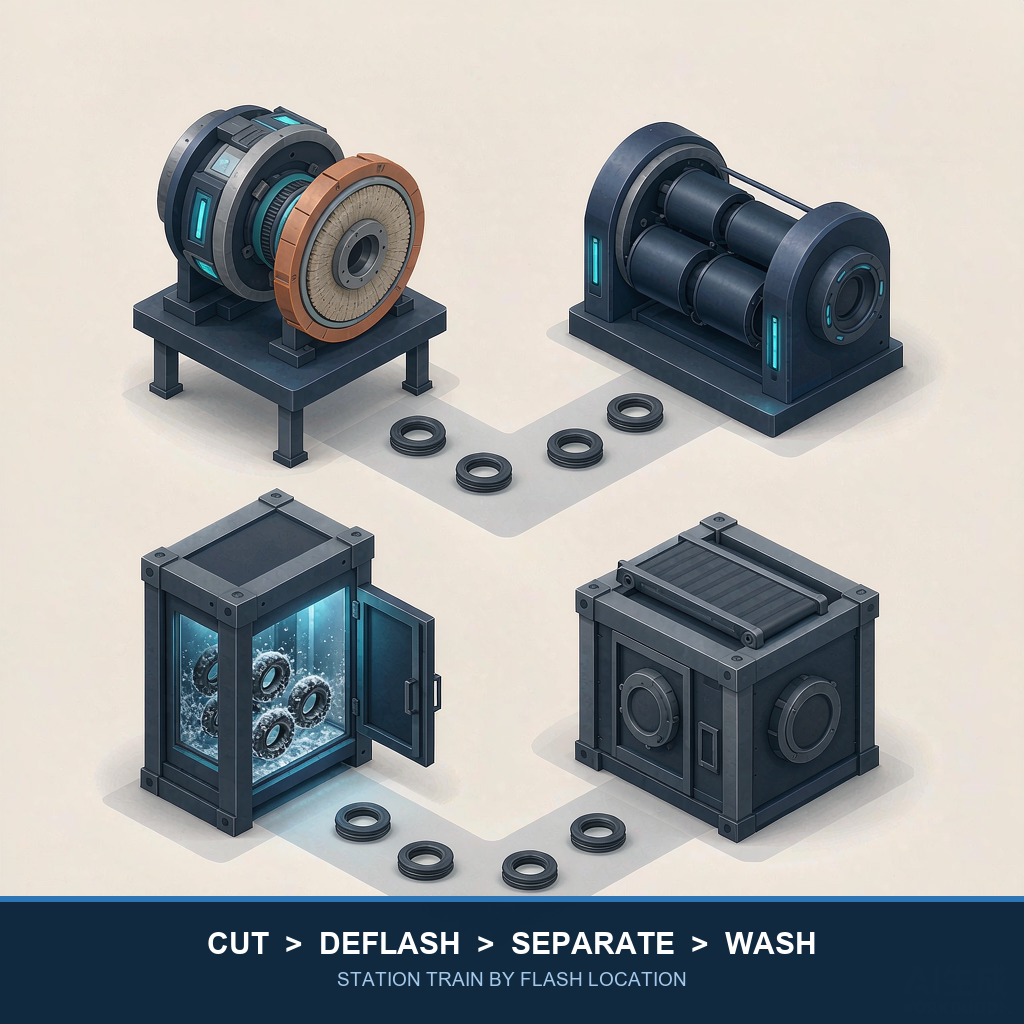
What Does the Separation Station Actually Protect?
After deflashing, good seals and loose flash leave the machine together. Separation is a quality gate, not a conveyor, because a single burr packed with a seal becomes a leak complaint at the customer. Vibration separators historically shook burrs along with the parts and needed a sieve change for every model change, which is where changeover time disappeared.
The XCJ-F600 air power separator handles 50kg per cycle with a 2.2kW motor and Delta touch screen on 304 stainless steel, occupies 2000 × 1000 × 2000mm, and needs no sieve change between models. That matters in a seal plant where twenty sizes in one shift is normal. For sticky silicone seals, the conveyor design also keeps residue out of packing.
How Do You Size the Train for a Mixed Seal Portfolio?
Sizing means matching batch sizes across stations so no station waits. Work the five steps in order and the equipment list writes itself.
- Group the portfolio by flash location. Sort every active part number into the five families in the first table and count each. A plant with 80% O-rings and 5% bonded washers needs a different train from one split evenly.
- Convert annual volume into batches per shift. Divide by real batch capacities — about 15kg for the mechanical barrel, 15-20kg for the 80L cryogenic roller, 50kg for the separator — then check whether the deflashing station or the press is the constraint.
- Measure flash thickness on ten parts per family. This single number decides mechanical versus cryogenic. Anything thinner than a few tenths of a millimetre on a complex section belongs in the cryogenic route.
- Fix the interfaces before signing. Confirm 3-phase 380V at the deflashing position, 0.5-0.8MPa air at the cutter, and roughly 10m² of floor for a cryogenic unit with auxiliaries.
- Standardize the batch unit. If the cutter fills bins of 12kg and the barrel takes 15kg, every batch carries an idle third. Aligning bin size to barrel load often recovers more capacity than a faster machine would.
Which Configuration Fits Which Seal Portfolio?
Three configurations cover most industrial seal plants. Choose by the mix you counted in step one, not by budget alone.
| Configuration | Station set | Best fit |
|---|---|---|
| Entry | Gasket cutter + mechanical barrel + air separator | Flat gaskets and simple O-rings, one or two sizes |
| Precision | Gasket cutter + cryogenic unit + air separator | O-rings, V-rings and small complex seals |
| Full train | Cutter + both deflashing routes + separator + wash | Mixed portfolio with lip seals and bonded parts |
Configuration tiers are typical values from our experience; each tier is assembled from catalog machines rather than custom builds.
One quality habit belongs in every tier: record the cutting tolerance and the batch cycle time for each family, because those two numbers predict seal performance far better than a visual check. Guidance from bodies such as the European Sealing Association treats the sealing interface as the governing surface — exactly what the flash-location rule protects — and a documented measurement routine is also what an ISO 9001 quality system expects to see at audit.
Conclusion: Buy the Station Train, Not the Machine
Equipment selection for industrial seals succeeds when the train is designed around flash location and batch compatibility, because a mismatched train costs more in changeover and scrap than any single machine saves. Start from the five families, measure flash thickness, align batch sizes, then buy. If you already own one deflashing route, the cheapest upgrade is usually the separation station, not a second deflashing machine.
Send us your seal drawing set with flash thickness and annual volume per family — we will return a station train proposal, including the deflashing machine range models that fit, within 48 hours.
Related Equipment Information
• XCJ-QGJ2-180# rubber gasket cutting machine — 10-180mm diameter, 240 cuts/min, ±0.05mm.
• XCJ-G600 mechanical deflashing machine — 600mm barrel, 7.5kW, 20-40s per 15kg batch.
• Liquid nitrogen cryogenic deflashing machine — -150°C, under 8 minutes per cycle, above 98% pass rate.
• XCJ-F600 air power separator — 50kg per cycle, no sieve change between models.
• Rubber cutting machine category — sheet, strip, slitter and gasket cutting stations.
Frequently Asked Questions: Industrial Seal Equipment Selection
Xiamen Xingchangjia Non-Standard Automation Equipment Co., Ltd.
Floor1, Building 13, Huli Industrial Park, Meixidao, Tongan, Xiamen China
Email: info@xcjrubber.com | Website: www.xmxcjrubber.com
Published: November 2026 | Last verified: November 2026
Post time: Nov-24-2026