




By Mike Chen, Production Director | 12+ Years in Rubber Manufacturing | LinkedIn
Key Takeaways
- O-ring deflashing method selection depends on five quantified factors: O-ring cross-section diameter, flash thickness, production volume per batch, material type, and tolerance class per ISO 3302-1.
- Mechanical deflashing with a drum-type machine processes O-rings from 3 mm to 100 mm outer diameter in 20-40 seconds per cycle and is generally the most cost-effective option for NBR, EPDM, and HNBR O-rings with flash above 0.2 mm.
- Cryogenic deflashing using liquid nitrogen at -100°C to -130°C is required for silicone (VMQ), FKM, and fluorosilicone O-rings with flash thinner than 0.2 mm, adding $0.007-0.03 per part in LN2 cost.
- A single XCJ-G600 drum deflashing machine can replace three older machines in high-volume O-ring production, achieving up to 90 parts per cycle at 15 kg batch capacity.
O-rings are the most widely produced sealing components in the rubber industry, and every molded O-ring carries flash along its parting line. The choice of deflashing machine affects not only the cosmetic appearance of the O-ring but its sealing performance, dimensional consistency, and production cost. This guide provides a quantified framework for matching deflashing equipment to O-ring production parameters.
O-Ring Deflashing Requirements: What Makes Them Different from Other Rubber Parts
O-rings present several deflashing challenges not found in other rubber products. Because a single O-ring mold produces dozens or hundreds of cavities, the parting line flash runs along both the inner diameter and the outer diameter of each ring. The thin cross-section — typical O-ring cross-sections range from 1.5 mm to 8.4 mm per ISO 3601-1 — means the flash is close to the functional sealing surface. Any over-deflashing that removes base material at the flash junction creates a leak path that cannot be detected by visual inspection alone.
Furthermore, O-rings are classified under ASTM D1414 for standard test methods, which specifies dimensional verification procedures that deflashing must not compromise. Per ISO 3302-1, the dimensional tolerances for precision O-rings range from ±0.08 mm for cross-sections under 2.5 mm to ±0.22 mm for cross-sections above 10 mm. The deflashing method must remove the flash without altering these critical dimensions.
A less obvious but equally important factor is flash location. O-ring molds typically have the parting line at the mold midpoint, meaning the flash sits directly on the seal diameter. Deflashing that leaves a remnant above 0.1 mm on the ID or OD creates a sealing defect that causes leakage at rated pressure. This geometry constraint makes deflashing method selection more critical for O-rings than for irregularly shaped rubber parts where flash is not on a functional surface.
Five Decision Factors for Selecting a Rubber Deflashing Machine for O-Rings
Factor 1: O-Ring Size Range and Cross-Section
The physical dimensions of your O-rings set the first equipment constraint. Mechanical drum deflashing machines operate within a defined diameter range. The XCJ-G600 drum deflashing machine, with its 600 mm drum diameter and 15 kg batch capacity, processes O-rings from 3 mm to 100 mm outer diameter. O-rings smaller than 3 mm tend to pass through the drum perforations or nest in clusters, reducing deflashing effectiveness. O-rings above 100 mm OD require a larger drum or alternative handling.
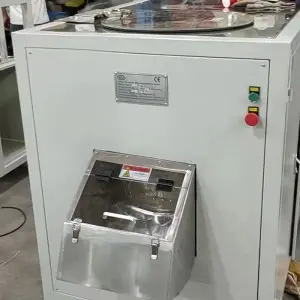
Cross-section also matters. Thin O-rings with cross-sections below 2 mm are more susceptible to flexing and surface damage during mechanical tumbling. For these, cryogenic processing is the safer choice because the frozen rubber behaves as a rigid material during media impact. A practical rule we use in our factory: O-rings with cross-section ≥2.5 mm and OD between 8 mm and 80 mm are the ideal candidates for mechanical drum deflashing, while O-rings outside this range should be evaluated for cryogenic processing.
Factor 2: Flash Profile and Material Type
Flash thickness is the single most important process parameter. Mechanical deflashing works effectively when the flash-to-part thickness ratio is 0.1 or higher — meaning a 3.5 mm cross-section O-ring with 0.35 mm flash can be deflashed mechanically, while a 1.8 mm cross-section with 0.15 mm flash cannot. For O-rings molded in high-cavitation tools where flash is typically 0.1-0.3 mm, the material determines whether mechanical or cryogenic deflashing is appropriate.
| Material | Recommended Deflashing Method | Flash Thickness Limit | Reason |
|---|---|---|---|
| NBR (Nitrile) | Mechanical (drum) | ≥0.20 mm | Good tear resistance; moderate flexibility |
| EPDM | Mechanical (drum) | ≥0.20 mm | Similar to NBR; flash fractures cleanly |
| HNBR | Mechanical (drum) | ≥0.15 mm | Higher strength allows thinner flash removal |
| FKM (Viton) | Cryogenic preferred | ≥0.10 mm (cryo) | Tough flash; best results at -110°C to -130°C |
| VMQ (Silicone) | Cryogenic mandatory | ≥0.08 mm (cryo) | Low tear strength; mechanical deflashing tears the part |
| FVMQ (Fluorosilicone) | Cryogenic mandatory | ≥0.08 mm (cryo) | Combines low tear strength with fuel resistance needs |
Flash thickness measured at the thickest point of the mold parting line. Actual values may vary by compound formulation and mold condition.
Factor 3: Production Volume and Batch Size
The XCJ-G600 processes a 15 kg batch of O-rings in 20-40 seconds per cycle. At an average O-ring weight of 2-10 grams depending on size, one batch contains 1,500-7,500 O-rings. At 40 seconds per batch with loading and unloading overhead, the effective throughput is approximately 60-80 batches per 8-hour shift, or 90,000-600,000 O-rings per shift depending on size.
High-volume production above 500,000 O-rings per day can justify a dedicated cryogenic line for the smaller sizes and a mechanical line for the main range, but for most mid-size producers, a single mechanical drum machine handles 80-90% of the O-ring portfolio. The remaining 10-20% — usually silicone or sub-6 mm ID O-rings — can be outsourced or run on a small cryogenic batch machine.
Factor 4: Tolerance Class and Quality Requirements
ISO 3302-1 classifies rubber product tolerances into four classes. Class A (precision) requires ±0.08 mm on cross-sections under 2.5 mm. Class B (fine) requires ±0.10 mm. Class C (medium) requires ±0.14 mm. The deflashing method must be capable of removing flash within the tolerance band without reducing the cross-section below the minimum allowable dimension. Mechanical deflashing with proper media selection achieves Class B and C tolerances consistently. Cryogenic deflashing, with its more controlled material removal, achieves Class A and B tolerances for O-rings with thin cross-sections. If your O-ring specification calls for Class A tolerances on cross-sections under 3 mm, cryogenic deflashing is strongly recommended.
Factor 5: Total Cost of Operation (TCO)
Two cost components are often underestimated in deflashing machine selection: media consumption and liquid nitrogen logistics. Mechanical deflashing consumes tumbling media (plastic or walnut shell pellets) that require periodic replacement. Cryogenic deflashing consumes liquid nitrogen at 0.5-2.5 kg per kg of rubber processed, depending on part mass and density.
| Cost Item | Mechanical (XCJ-G600) | Cryogenic (Batch) |
|---|---|---|
| Machine purchase price | $8,000-15,000 | $25,000-60,000 |
| Operating cost per kg of O-rings | $0.08-0.15 (media + energy) | $0.25-0.60 (LN2 + energy) |
| Maintenance cost per year | $500-1,200 | $1,200-3,000 (LN2 pump + valves) |
| Cycle time per batch | 20-40 seconds | 3-8 minutes (including freeze time) |
| Floor space required | 2.0 m x 1.5 m | 3.5 m x 2.5 m (with LN2 tank) |
| Payback period (typical) | 6-12 months | 12-24 months |
Costs based on 2026 Q2 estimates for equipment operating in China. LN2 pricing varies regionally; bulk delivery reduces cost by 15-25%.
⚠️ Hidden Cost: Flash Thickness Variability
If your mold maintenance is inconsistent, flash thickness can vary by 0.3 mm across cavities. This variability forces you to choose a deflashing method and parameters for the thickest flash, which may over-process O-rings from tighter cavities. Invest in mold inspection every 20,000 cycles and maintain vent depths within 0.05 mm. This single step reduces deflashing rejects by 30-40% in our production experience.
Decision Framework: Which Rubber Deflashing Machine for O-Rings Fits Your Production?
Choose a Mechanical Drum Deflashing Machine When:
✓ Your O-rings are NBR, EPDM, or HNBR with cross-section ≥2.5 mm
✓ Flash thickness is consistently 0.2 mm or above (well-maintained molds)
✓ Outer diameter range is 6-90 mm
✓ Daily production is above 50,000 O-rings
✓ Target tolerance class is B or C
✓ Floor space and LN2 supply logistics are constraints
Choose a Cryogenic Deflashing Machine When:
✓ Your O-rings are silicone (VMQ), FKM, or FVMQ
✓ Flash thickness is consistently 0.15 mm or below
✓ O-ring inner diameter is below 6 mm (small and prone to nesting in mechanical drums)
✓ Cross-section is below 2.0 mm (thin and flexible)
✓ Target tolerance class is A (precision applications like aerospace or medical devices)
✓ The deflashing method must be compatible with cleanroom or medical-grade production
Many manufacturers use a mixed approach: an XCJ-G600 mechanical drum deflashing machine handles the primary NBR and EPDM production, while a small cryogenic machine processes the silicone and FKM O-rings that represent 10-20% of the product mix. This arrangement maximizes throughput on the most common materials while maintaining quality on the specialty compounds.
Conclusion: Match the Deflashing Machine to Your O-Ring Portfolio
There is no single best rubber deflashing machine for O-rings. The correct choice depends on O-ring dimensions, material type, flash condition, production volume, and tolerance requirements. Mechanical drum deflashing with the XCJ-G600 is the most cost-effective solution for standard NBR and EPDM O-rings in the 6-90 mm OD range, offering 20-40 second cycle times at 15 kg per batch. Cryogenic deflashing becomes necessary for silicone and FKM O-rings, small IDs below 6 mm, and precision Class A tolerance applications. For mixed-production facilities, running both methods in parallel maximizes flexibility without compromising cost efficiency on high-volume standard materials.
Related Equipment Information
• XCJ-G600 rubber deflashing machine — High-speed drum deflashing for O-rings from 3 mm to 100 mm OD with 20-40 second cycle time.
• Liquid nitrogen cryogenic deflashing machine — Process silicone, FKM, and precision O-rings at -100°C to -130°C.
• Complete rubber processing equipment — Browse deflashing, cutting, cleaning, and curing machines for O-ring production lines.
Frequently Asked Questions: Choosing an O-Ring Deflashing Machine
Xiamen Xingchangjia Non-Standard Automation Equipment Co., Ltd.
Floor1, Building 13, Huli Industrial Park, Meixidao, Tongan, Xiamen China
Email: info@xcjrubber.com | Website: www.xmxcjrubber.com
Published: July 2026 | Last reviewed: 2026-07-28
Post time: Jul-28-2026