




By Mike Chen, Production Director | 12+ Years in Rubber Manufacturing | LinkedIn
Key Takeaways
- Hydraulic system seals require flash removal to within 0.1 mm because leftover flash causes internal leakage and premature seal failure in high-pressure circuits.
- Mechanical deflashing achieves 20-40 second per-seal cycle times on standard O-rings and wiper seals, making it 40-50 times faster than manual trimming.
- Cryogenic deflashing at -100°C to -130°C is recommended for silicone and FKM hydraulic seals with thin flash below 0.3 mm that resists mechanical abrasion.
- The XCJ-G600 mechanical deflashing machine processes 15 kg batches of hydraulic seals per cycle, enough for over 3,000 O-rings per shift at standard production volumes.
Cryogenic Deflashing Process: Liquid Nitrogen vs Dry Ice
Cryogenic deflashing relies on controlled cooling to selectively embrittle mold flash while preserving the base part’s flexibility. The choice of cooling medium determines the minimum temperature achievable, the cooling rate, and the per-part operating cost. Understanding these differences helps manufacturers select the right cryogenic deflashing process for their production requirements.
Because liquid nitrogen and dry ice have fundamentally different physical properties — LN₂ is a cryogenic liquid stored at -196°C, while dry ice is solid CO₂ that sublimates at -78.5°C — each medium creates different processing conditions for the cryogenic deflashing process.
This comparison examines five dimensions of the cryogenic deflashing process using liquid nitrogen versus dry ice: temperature performance, operating cost, cooling rate, material compatibility, and equipment requirements.
How the Cryogenic Deflashing Process Works with Different Cooling Media
The cryogenic deflashing process follows the same principle regardless of cooling medium: rubber parts are cooled below the embrittlement temperature of the flash material, then blasting media impacts the frozen parts to fracture and remove the brittle flash. The key variable is the temperature the cooling medium can achieve and maintain inside the processing chamber.
Liquid nitrogen cryogenic deflashing process
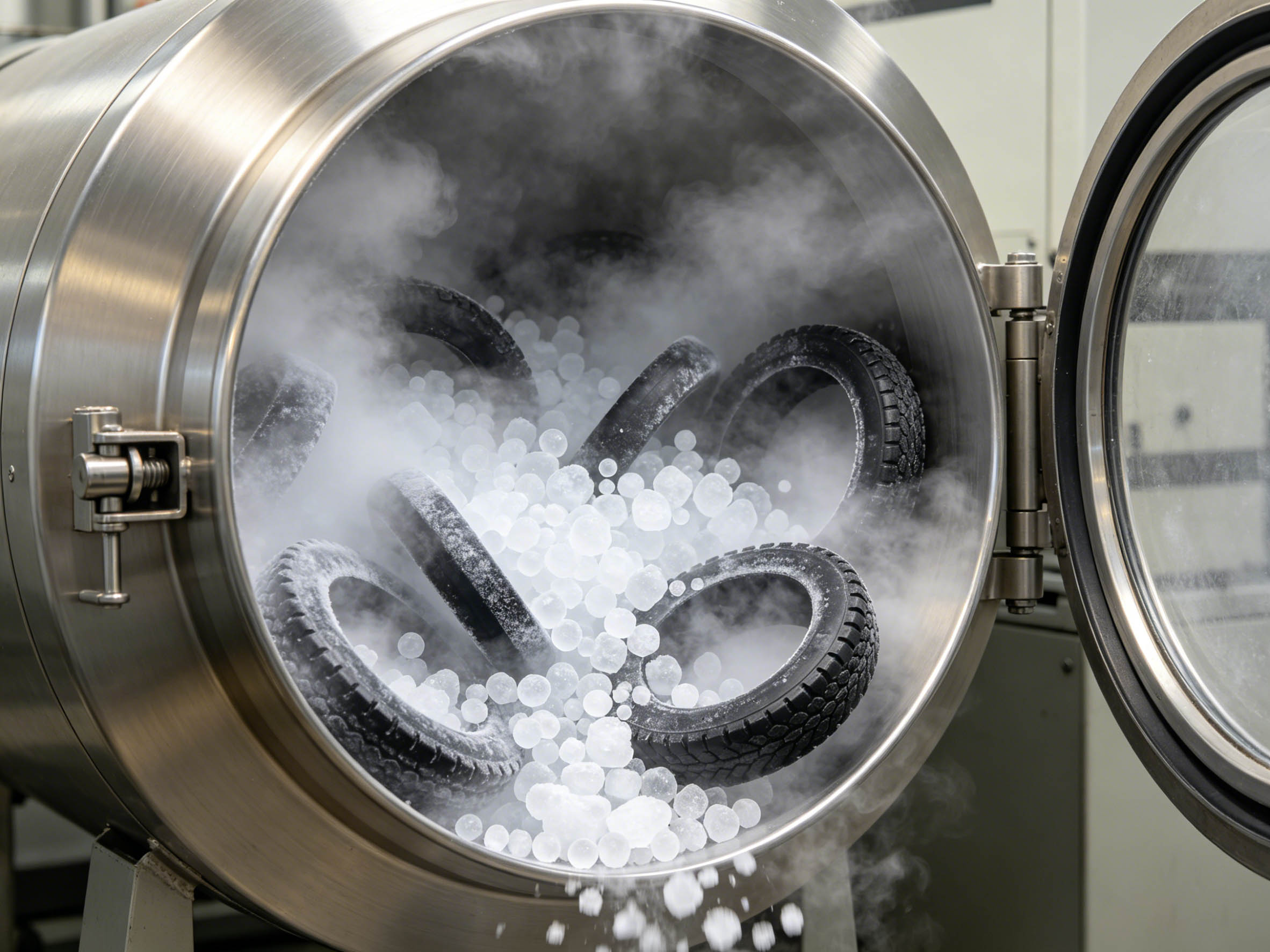
Liquid nitrogen is injected into the sealed deflashing chamber at controlled rates to maintain temperatures between -100°C and -130°C. At these temperatures, rubber flash becomes sufficiently brittle to fracture under media impact, while the thicker base part body retains its structural integrity. The LN₂ is stored in pressurized dewars or bulk tanks and delivered to the machine through vacuum-insulated piping. Temperature control within ±5°C is achievable with modern solenoid-valve injection systems.
Dry ice deflashing process details
Dry ice can be used for cryogenic deflashing in two forms: solid pellets added directly to the tumbling drum, or CO₂ snow produced by expanding liquid CO₂ through a nozzle. Solid dry ice pellets at -78.5°C are mixed with rubber parts in the deflashing chamber. Because the sublimation temperature of CO₂ is higher than LN₂’s boiling point, the cooling rate is slower, typically requiring 30-50% longer freeze times to achieve equivalent flash embrittlement. Dry ice deflashing is most effective on thicker flash profiles above 0.3 mm where embrittlement at -78.5°C is sufficient.
Liquid Nitrogen vs Dry Ice: Key Comparison Dimensions
| Comparison Dimension | Liquid Nitrogen (LN₂) | Dry Ice (CO₂) |
|---|---|---|
| Temperature achieved | -100°C to -130°C (adjustable) | -60°C to -78.5°C (fixed by sublimation point) |
| Cooling rate (15 kg batch) | 3-5 minutes to reach -120°C | 6-10 minutes to reach -70°C |
| Per-batch cooling cost | $5-15 (20-50 kg LN₂ at $0.15-0.30/kg) | $12-30 (15-30 kg dry ice at $0.50-1.00/kg) |
| Minimum removable flash | ~0.05 mm at -120°C | ~0.2 mm at -78.5°C |
| Cycle time (15 kg batch) | 10-20 minutes total | 18-35 minutes total (longer freeze phase) |
| Equipment complexity | Standard — widely available with LN₂ delivery infrastructure | Non-standard — limited machine availability, requires dry ice production or storage |
| Silicone / FKM compatibility | Excellent — full embrittlement | Limited — partial embrittlement, silicone may remain flexible |
Cost estimates based on standard industrial gas pricing in North American and Asian markets as of Q2 2026. Actual pricing varies by geographic region, supplier agreements, and purchase volume.
Temperature Performance: Liquid Nitrogen vs Dry Ice in the Cryogenic Deflashing Process
Liquid nitrogen achieves a processing temperature of -100°C to -130°C, which is sufficient to embrittle the full range of rubber compounds used in molded parts, including EPDM (glass transition temperature Tg ≈ -45°C to -55°C), NBR (Tg ≈ -25°C to -40°C), FKM (Tg ≈ -15°C to -25°C), and silicone rubber (Tg ≈ -120°C to -125°C). Because LN₂ at -196°C provides a substantial temperature margin above the required embrittlement point, the cryogenic deflashing process with LN₂ is stable even during heavy batch loading when the chamber temperature rises temporarily.
Dry ice at -78.5°C cannot reach the typical processing range of -100°C to -130°C used for precision cryogenic deflashing. For silicone rubber with a Tg near -120°C, dry ice cannot achieve full embrittlement regardless of exposure time. For EPDM and NBR parts with thicker flash, dry ice may provide sufficient embrittlement at -78.5°C, but the margin above Tg is smaller, meaning process stability is reduced during high-throughput operation.
Cryogenic Deflashing Process Cost: Liquid Nitrogen vs Dry Ice Per Batch
Liquid nitrogen is the more economical cooling medium for the cryogenic deflashing process when calculated per unit of cooling capacity. At $0.15-0.30 per kilogram, LN₂ provides approximately 200 kJ/kg of latent heat of vaporization. Dry ice at $0.50-1.00 per kilogram provides approximately 570 kJ/kg of sublimation energy, but the higher material cost and the lower achievable temperature mean more dry ice is typically needed per batch to achieve equivalent flash removal results.
For a standard 15 kg batch of rubber O-rings, the cryogenic deflashing process with LN₂ uses 20-50 kg of nitrogen at a cost of $5-15 per batch. Using dry ice for the same batch, 15-30 kg of dry ice costs $12-30 per batch. When cycle time differences are factored in — LN₂ completes the batch in 10-20 minutes versus 18-35 minutes for dry ice — the per-hour production cost of LN₂ cryogenic deflashing is approximately 40-60% lower.
The cost comparison changes for facilities that already use dry ice for other cleaning applications. In these cases, the marginal cost of diverting dry ice to deflashing may be lower than establishing a new LN₂ supply contract. However, dedicated cryogenic deflashing systems are almost universally designed for liquid nitrogen due to its superior temperature range and faster cycle times.
Material Compatibility in Cryogenic Deflashing: LN₂ vs Dry Ice
| Rubber Compound | Tg Range | LN₂ (-120°C) Effectiveness | Dry Ice (-78.5°C) Effectiveness |
|---|---|---|---|
| EPDM | -45°C to -55°C | Full embrittlement | Full embrittlement |
| NBR / Nitrile | -25°C to -40°C | Full embrittlement | Full embrittlement |
| FKM / Fluoroelastomer | -15°C to -25°C | Full embrittlement | Full embrittlement |
| Silicone Rubber (VMQ) | -120°C to -125°C | Full embrittlement | Partial — may remain flexible |
| HNBR | -20°C to -30°C | Full embrittlement | Full embrittlement |
| PU / Polyurethane | -30°C to -50°C | Full embrittlement | Good — may require longer cycle |
Glass transition temperature (Tg) ranges per ISO 1629 material classification. Actual Tg varies by compound formulation. Testing per ASTM D746 or ISO 812 is recommended to determine the specific embrittlement temperature for each formulation.
The material compatibility data shows that liquid nitrogen is the universal solution for the cryogenic deflashing process, while dry ice is limited to compounds with Tg values above -60°C. Silicone rubber, which has a Tg near -120°C, cannot be fully processed with dry ice alone regardless of exposure time or cooling method.
Equipment for Cryogenic Deflashing: LN₂ vs Dry Ice Systems
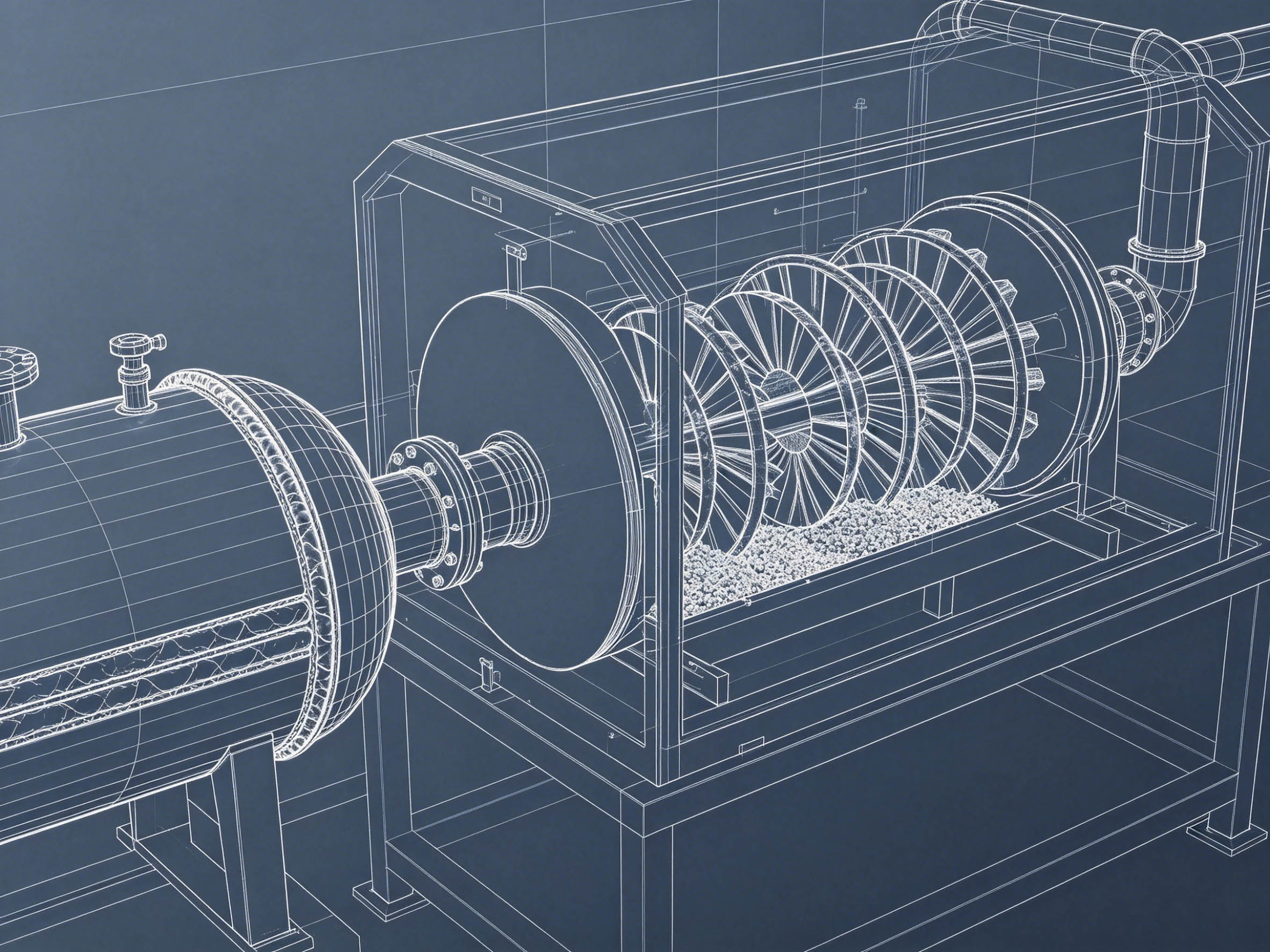
The equipment for LN₂-based cryogenic deflashing is standardized and widely available. A typical system includes a vacuum-insulated storage tank, a temperature-controlled injection manifold, a sealed processing chamber with tumbling mechanism, a media blasting system, and exhaust ventilation. Temperature control is managed through thermocouple feedback loops that regulate LN₂ injection rates. These systems are available from multiple manufacturers with chamber sizes ranging from 30 liters to 500 liters.
Dry ice cryogenic deflashing equipment is less standardized. Common configurations include adding dry ice pellets directly to a standard tumbling drum, or using a CO₂ snow horn in a modified chamber. The lack of consistent equipment availability means dry ice cryogenic deflashing is typically used only in facilities that have adapted existing equipment for this purpose. Per OSHA guidelines for cryogenic gas handling, both LN₂ and dry ice systems require oxygen deficiency monitoring, pressure relief systems, and operator protective equipment.
Cryogenic Deflashing Process Selection: Which Cooling Medium Should You Choose?
Choose liquid nitrogen for your cryogenic deflashing process when:
- Processing silicone or FKM rubber compounds that require temperatures below -80°C
- Thin flash below 0.2 mm requires consistent embrittlement across the entire batch
- Production volume exceeds 500 kg per day, making per-part cost a priority
- Equipment reliability and manufacturer support are important factors
- Cycle time targets require freeze times under 5 minutes per batch
Consider dry ice as an alternative when:
- Your facility already uses dry ice for other cleaning or cooling operations
- All processed parts have glass transition temperatures above -60°C
- Flash thickness is consistently above 0.3 mm and embrittlement at -78.5°C is sufficient
- Liquid nitrogen supply infrastructure is unavailable or cost-prohibitive in your region
- Production volume is low (under 200 kg per day) and cycle time is not the primary concern
For most rubber manufacturing operations, liquid nitrogen is the recommended cooling medium for the cryogenic deflashing process because of its lower per-batch cost, faster cycle times, and broader material compatibility. Dry ice cryogenic deflashing is a viable secondary option only under the specific conditions listed above.
Conclusion: Choosing the Right Cooling Medium for Your Cryogenic Deflashing Process
The cryogenic deflashing process offers two cooling media options with distinctly different performance profiles. Liquid nitrogen at -196°C provides the temperature range, cooling rate, and cost efficiency needed for most production environments. Dry ice at -78.5°C is a niche alternative suitable only for facilities processing compounds with Tg values above -60°C and flash thickness above 0.3 mm.
For manufacturers investing in a new cryogenic deflashing system, liquid nitrogen is the standard choice supported by established equipment manufacturers, consistent supply chains, and proven process data. Dry ice deflashing should be evaluated only when existing dry ice infrastructure or regional LN₂ supply limitations make it the more practical option.
Related Equipment Information
• Review XCJ-G600 mechanical deflashing machine specifications for non-cryogenic flash removal applications.
• Explore complete rubber deflashing and processing equipment range at Xiamen Xingchangjia.
• See rubber gasket cutting machine for downstream processing of deflashed rubber components.
• View rubber slitter and cutting machine for sheet-to-strip processing before molding.
Frequently Asked Questions: Cryogenic Deflashing Process with LN₂ vs Dry Ice
What temperature does a cryogenic deflashing process using liquid nitrogen achieve?
Can dry ice fully replace liquid nitrogen in the cryogenic deflashing process?
How much does dry ice cost compared to liquid nitrogen for cryogenic deflashing?
Which rubber compounds require liquid nitrogen instead of dry ice for flash removal?
What safety equipment is required for a cryogenic deflashing process with liquid nitrogen?
How does the cooling rate differ between LN₂ and dry ice in cryogenic deflashing?
Xiamen Xingchangjia Non-Standard Automation Equipment Co., Ltd.
Floor1, Building 13, Huli Industrial Park, Meixidao, Tongan, Xiamen China
Email: info@xcjrubber.com | Website: www.xmxcjrubber.com
Post time: Jun-30-2026