




Key Takeaways
- Medical grade rubber hinges on three layers — an ISO 13485 quality system, ISO 10993 biocompatibility testing, and FDA 21 CFR 177.2600 material compliance — not on any one certificate.
- Contamination control decides most audits: a 304 stainless drum washer running 12 kW cleans 15–30 kg per load and uses about 0.1 tons of water in a 6-minute pass.
- Mechanical deflashing trims 20–40 seconds per O-ring on a ~15 kg batch, while cryogenic deflashing at −150°C clears a cycle in under 8 minutes at over 98% pass rates.
- Cutting tolerance, not cutting speed, releases a medical part: CNC strip cutting holds 0–20 mm thickness at 80 strokes per minute across 600–1000 mm widths.
The short answer: Medical grade rubber processing equipment standards combine a certified quality system (ISO 13485), material biocompatibility testing (ISO 10993 and USP Class VI), and process controls that keep molded parts free of flash, mold release and particulate from molding through packaging. No single machine makes a part medical grade — the standard is only met when every stage, from cutting and molding to deflashing, cleaning, drying and inspection, is controlled and documented.
A medical device manufacturer cannot simply order “the medical version” of a cutting or deflashing machine. What makes a rubber O-ring or gasket medical grade is the chain of validated equipment and records behind it, not one certificate bolted onto one machine.
That distinction matters at the buying stage, because the equipment you choose for cutting, deflashing and cleaning decides whether you pass an audit later. This guide maps the standards that apply at each production stage and the machines that support them.
What Makes Rubber “Medical Grade”?
Medical grade rubber is defined by three layers of evidence, never by a single material property. The first layer is the quality system — ISO 13485:2016 requires documented process validation and traceability for anything touching a medical device. The second is biocompatibility: compounds for patient or fluid contact are typically screened under ISO 10993-1, and drug-contact elastomers are often tested to USP Class VI. The third is material compliance, such as FDA 21 CFR 177.2600 for rubber articles intended for repeated contact.
Because these requirements describe the whole chain, equipment that was fine for an industrial seal often fails a medical audit.
Which Standards Apply at Each Stage of Rubber Processing?
The standard follows the part through every station. Cutting, molding, deflashing, cleaning, drying and inspection each carry their own control requirement, and the equipment must support it from day one.
| Production stage | Governing requirement | What it controls | Equipment implication |
|---|---|---|---|
| Material receiving | ISO 13485 purchasing controls | Lot identity, shelf life | Sealed storage, FIFO |
| Cutting | ISO 13485 process validation | Dimensional repeatability | Stainless contact surfaces |
| Molding | ISO 13485 + FDA 21 CFR 177.2600 | Cure, mold release, flash | Documented mold release |
| Deflashing | ISO 13485 + ISO 10993 residue limits | Flash removal, media residue | Contained-media systems |
| Cleaning & drying | ISO 13485 + ISO 10993-17 limits | Mold release, dust, particulate | Multi-stage wash, filtered air |
| Inspection & packing | ISO 13485 traceability | AQL sampling, lot release | Documented release records |
Stage mapping follows ISO 13485 and ISO 10993 principles; the equipment column reflects standard medical rubber practice.
How Do You Stop Contamination Between Molding and Packaging?
Contamination control is where most medical rubber lines lose their audit. Every surface the part touches after molding should be stainless steel, washed on a defined cycle, and dried with filtered air.
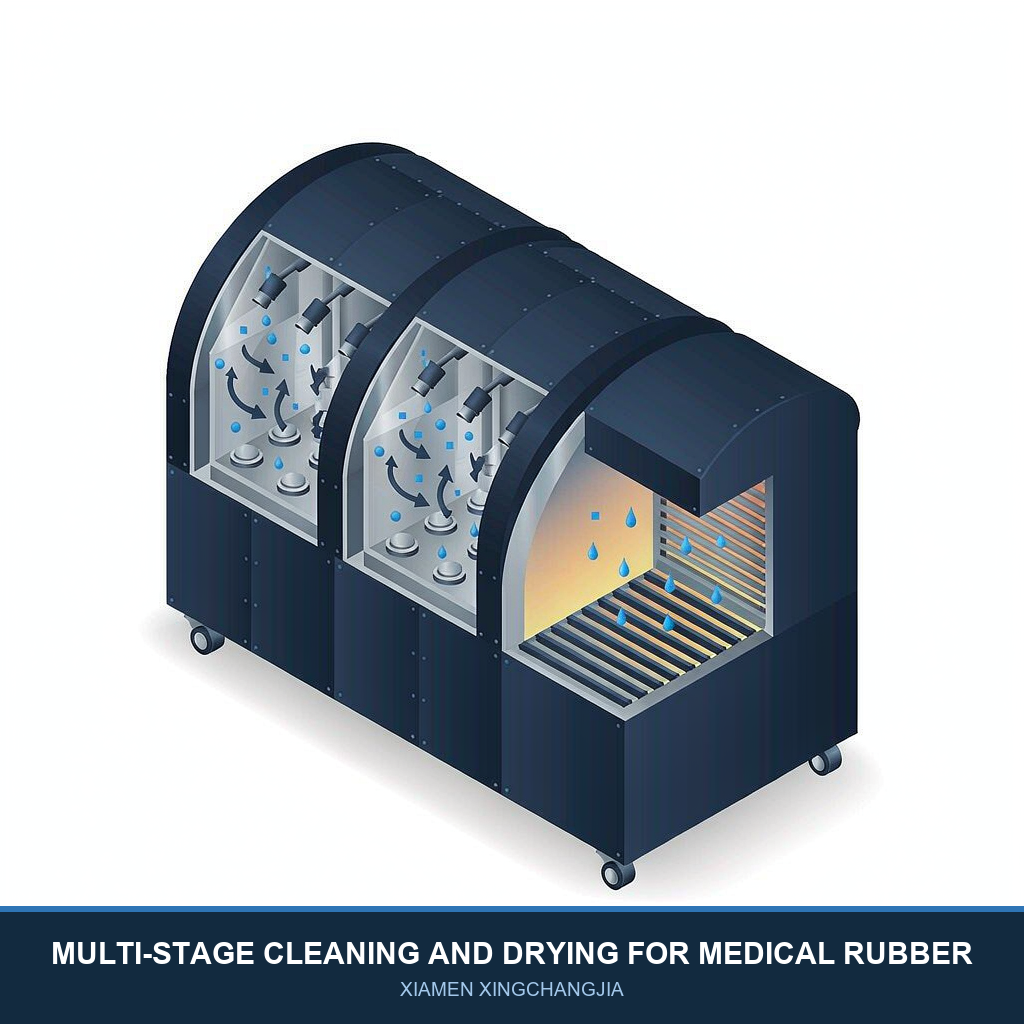
A representative example is the XCJ-QXJ 600 cleaning and drying machine, built from thickened 304 stainless steel with three groups of six-stage cleaning procedures that can be combined freely. Its roller drum is 600 mm in diameter and 1000 mm long, handling 15–30 kg per load, with 12 kW total power at 380 V and a footprint of 1520 × 1050 × 1720 mm.
The process is a positive-and-reverse high-pressure spray: fan nozzles and a multi-stage centrifugal pump rotate the drum so there is no blind spot on the parts, then an air pre-drying stage and a ceramic heater finish the cycle. A single cleaning pass takes about 6 minutes and uses roughly 0.1 tons of water, while a full clean-and-dry cycle consumes about 2.5 kWh.
Which Deflashing Method Is Safe for Medical Parts?
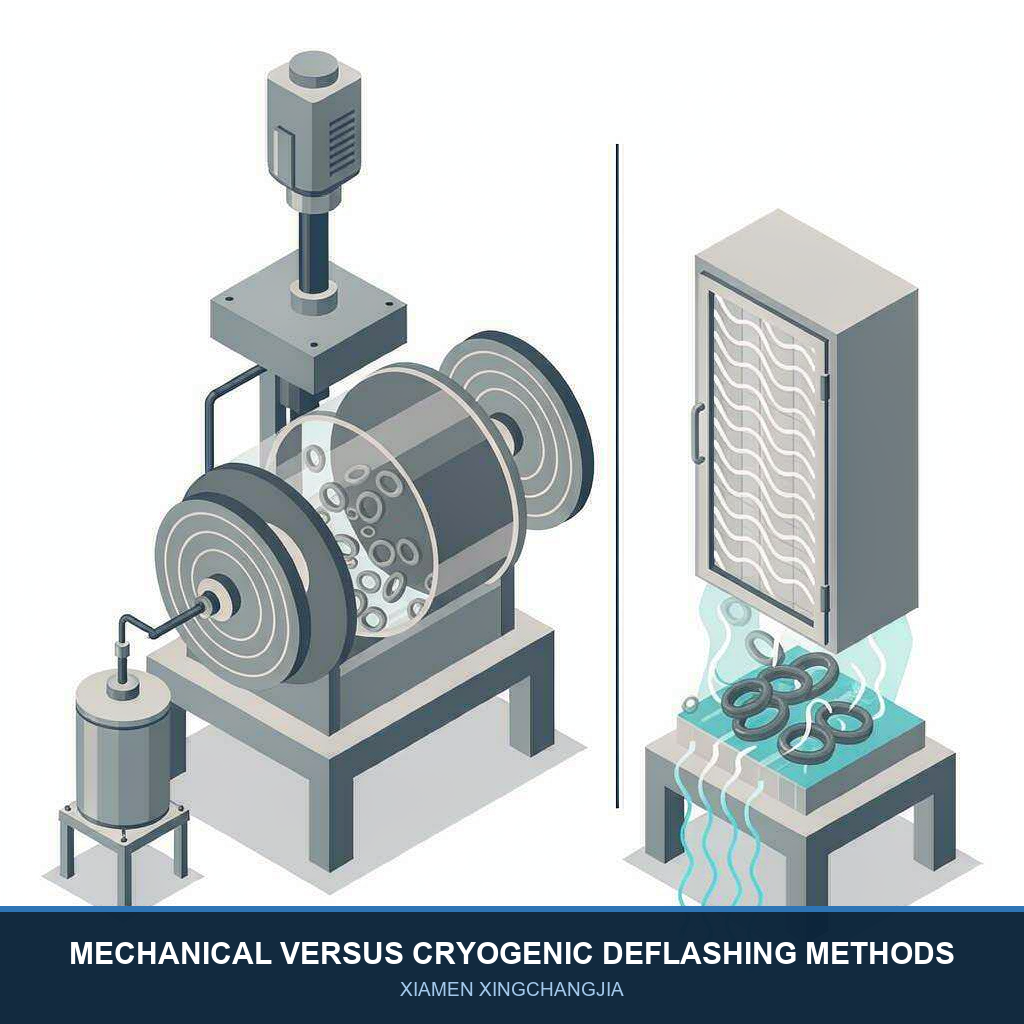
Both mechanical and cryogenic deflashing can be validated for medical rubber, but they fail in different ways, so the choice should follow part geometry and media risk. Mechanical deflashing suits robust parts; cryogenic deflashing suits thin flash and delicate geometry where mechanical force would deform the part.
| Method | How it works | Typical cycle | Best for | Watch-outs |
|---|---|---|---|---|
| Mechanical (barrel / air) | Rotating barrel with controlled abrasion or air flow | 20–40 s per O-ring batch | Robust O-rings, gaskets, seals | Part contact, media residue |
| Cryogenic (liquid nitrogen) | Flash embrittled at low temperature, then tumbled | Under 8 minutes per cycle | Thin flash, micro parts, delicate seals | Nitrogen handling, condensation |
| Manual trimming | Hand or bench trimming | Minutes per part | Prototypes, very low volume | Weak process control |
Cycle times reflect published equipment specifications from the XCJ machine pages.
The super-model mechanical deflashing machine benchmarks high-volume parts. Its barrel is 600 mm deep and 600 mm in diameter, driven by a 7.5 kW motor with an inverter, in a footprint of 1750 × 1000 × 1000 mm. It trims 20–40 seconds per O-ring on a roughly 15 kg batch load, so one unit replaces three older machines.
For delicate micro-parts, a cryogenic system is usually safer. The liquid nitrogen cryogenic deflashing machine holds an 80 L roller (about 15–20 kg) at a maximum temperature of −150°C, completes one cycle in under 8 minutes, and runs on 1.1 kW of rated refrigeration at 3-phase 380 V / 50 Hz, with roller speed adjustable from 20 to 70 RPM. Published pass rates stay above 98%.
How Do You Validate Cutting and Dimensional Accuracy?
Cutting sets the starting dimension of every molded blank, so its tolerance capability has to be proven, not assumed. For medical seals the validation question is not how fast the machine cuts, but how repeatably it holds thickness, because scrap and rework trace back to blank variation.
A CNC rubber strip cutting machine expresses that repeatability in measurable terms: strip widths from 600 mm to 1000 mm across three standard sizes, a cutting thickness range of 0–20 mm, and 80 strokes per minute. Motor power scales with width — 1.5 kW on the 600 mm model and 2.5 kW on the 800 mm and 1000 mm models.
Validation tip: qualify before you release
Run installation, operational and performance qualification before the first commercial lot. Record blank thickness on 30 pieces at three positions across the strip; if the standard deviation exceeds your molding tolerance, adjust the machine — not the inspection limits.
A simple validation sequence looks like this:
- Freeze the specification. Define the target thickness, allowable range and sampling plan before any test run.
- Qualify the machine empty. Confirm blade alignment, feed rate and safety interlocks behave as specified.
- Run the performance test. Cut 30 pieces, measure thickness at the centre and both edges, then calculate standard deviation.
- Compare against molding tolerance. Verify the worst-case blank still produces a conforming molded part.
- Record the evidence. Attach the raw measurements to the equipment record so the audit trail points to data.
Across the rubber cutting lines we commission, typical values from our experience are a blank thickness spread of ±0.15 mm on a well-maintained CNC strip cutter, widening to ±0.4 mm once blade wear passes its service interval — which is why blade maintenance belongs inside the validation cycle, not outside it.
What Documentation Must Travel With Every Batch?
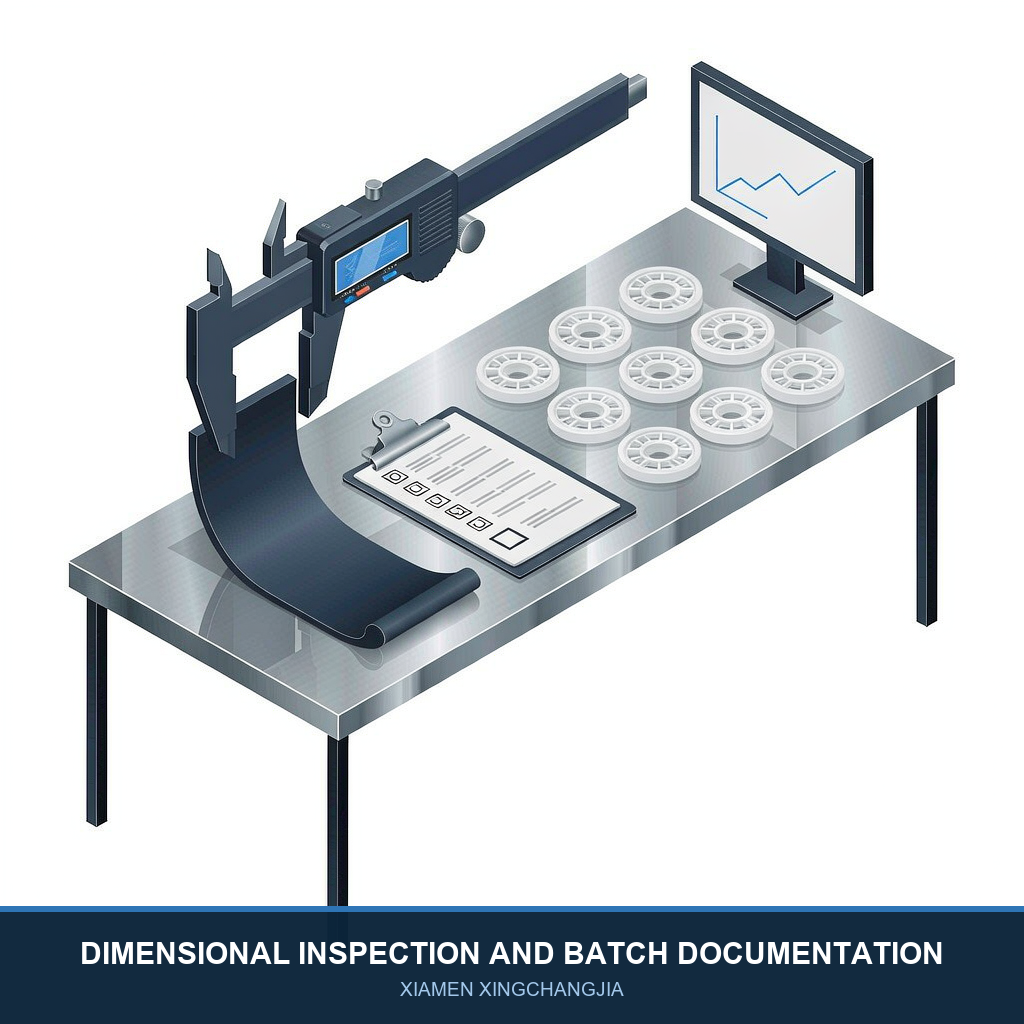
Documentation is what turns good manufacturing into a medical grade record. Every batch should carry four linked records, and a gap in any one of them is the most common reason a medical rubber line fails an audit.
Audit-ready checklist
Keep four documents current: IQ/OQ/PQ reports for cutting, deflashing and cleaning equipment; in-process dimensional data with the sampling plan; cleaning and drying cycle logs; and lot traceability from compound batch to shipped carton.
Conclusion: Building a Medical Rubber Line That Passes Audit
Medical grade rubber processing equipment standards are not a certificate you buy once; they are a chain of validated stages, each with its own documentation. If cutting holds thickness repeatably, deflashing matches the part, cleaning and drying are stainless and cycle-logged, and every batch keeps its records, the line will pass an audit.
The equipment choices are concrete: a CNC strip cutter holding 0–20 mm thickness at 80 strokes per minute, a 600 mm barrel deflashing machine trimming 20–40 seconds per O-ring, or a −150°C cryogenic system protecting delicate parts at over 98% pass rate, plus a 304 stainless cleaning and drying line completing a documented cycle in about 20 minutes.
If you are specifying a medical rubber line, map your part to the standards above, then match each station to a machine whose published parameters support that requirement.
Related Equipment Information
• Rubber deflashing machine (Super Model) XCJ-G600 — 600 × 600 mm barrel, 7.5 kW inverter motor, 20–40 s per O-ring batch.
• Liquid nitrogen cryogenic deflashing machine — −150°C, 80 L roller, under 8 minutes per cycle.
• Rubber cleaning and drying machine XCJ-QXJ 600 — 304 stainless drum, six-stage wash, 15–30 kg per load.
• Rubber cutting machine range — CNC strip cutting, slitting, gasket and silicone cutting options.
Frequently Asked Questions: Medical Grade Rubber Equipment
Xiamen Xingchangjia Non-Standard Automation Equipment Co., Ltd.
Floor1, Building 13, Huli Industrial Park, Meixidao, Tongan, Xiamen China
Email: info@xcjrubber.com | Website: www.xmxcjrubber.com
Published: October 2026 | Last verified: October 2026
Post time: Oct-08-2026