




Key Takeaways
- CNC rubber sheet cutting machines cut a continuous 0-20 mm thickness range at 80 cuts per minute.
- Three working widths are available: 600 mm, 800 mm and 1,000 mm benches, all with 0-1,000 mm shear length.
- Servo feeding accuracy is 0.1 mm; profile and ring cuts hold 0.05 mm on the gasket cutting machine.
- Motor power scales with width: 1.5 kW on the 600 mm model, 2.5 kW on the 800 and 1,000 mm models (450 to 1,200 kg).
The short answer: A rubber sheet cutting machine handles sheet stock 0-20 mm thick at working widths up to 1,000 mm. Three bench widths (600 mm, 800 mm and 1,000 mm) all cut the full 0-20 mm range at 80 cuts per minute, with servo feeding accuracy of 0.1 mm. Because wider, thicker stock demands more motor power, the 800 and 1,000 mm models carry 2.5 kW drives instead of the 1.5 kW motor on the 600 mm bench.
When a workshop moves from hand cutting to automation, the first question is whether one machine will cover the whole sheet inventory. Machines are specified by two numbers: maximum thickness and maximum width. Those two figures define the capability envelope of everything else you cut.
This guide maps that envelope from verified CNC specifications and closes with a five-step model-selection workflow.
What Thickness Range Can a Rubber Sheet Cutting Machine Handle?
The CNC platform cuts a continuous 0-20 mm thickness range, and that range does not change between width models. All three benches shear the same 0-20 mm span at 80 cuts per minute, so one machine covers thin films, mid-range gasket stock and thick slabs without a second purchase.
The knife is a special steel blade with a bevel-type shear design. Because the bevel reduces friction as the blade enters the stock, cuts stay clean across the range and the blade wears slower. The slider runs on high-precision linear guide rails of CNC machine-tool grade, which is why cut faces stay square even on 20 mm slabs.
| Model (bench width) | Cutting thickness | Shear length | Cutting rate | Motor | Net weight | Dimensions (mm) |
|---|---|---|---|---|---|---|
| 600 mm | 0-20 mm | 0-1000 mm | 80 cuts/min | 1.5 kW-6 | 450 kg | 1100 x 1400 x 1200 |
| 800 mm | 0-20 mm | 0-1000 mm | 80 cuts/min | 2.5 kW-6 | 600 kg | 1300 x 1400 x 1200 |
| 1000 mm | 0-20 mm | 0-1000 mm | 80 cuts/min | 2.5 kW-6 | 1200 kg | 1500 x 1400 x 1200 |
Source: manufacturer specifications for the CNC rubber strip cutting machine (adaptable metal), xmxcjrubber.com.
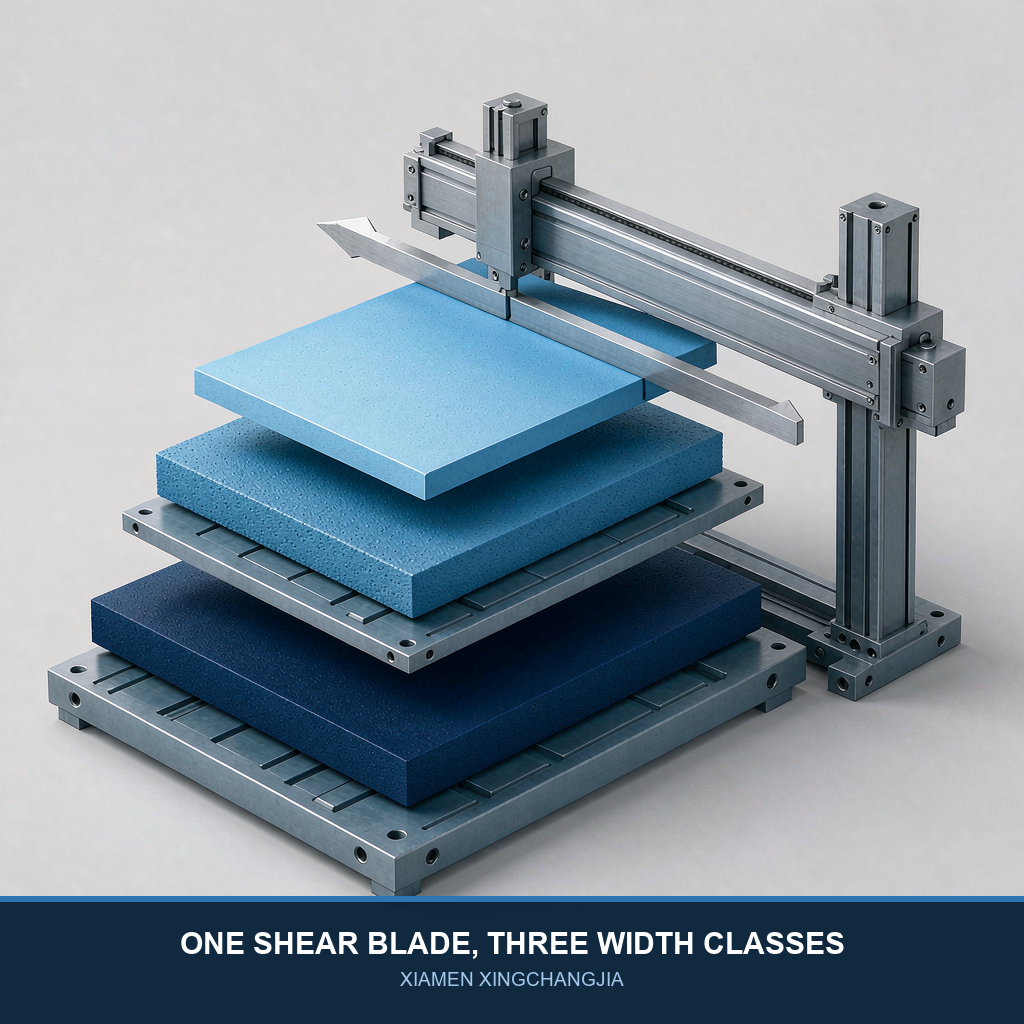
Capability also depends on material: the platform cuts natural rubber, synthetic rubber, plastics and certain hardness metals into strips, blocks and filaments. Harder compounds at the 12-20 mm end lean harder on the knife, so the 2.5 kW models are the safer choice for sustained thick-stock work.
| Thickness band | Typical cutting behavior | What to watch |
|---|---|---|
| 0-3 mm (film and thin sheet) | Cleanest shear, lowest knife load | Sheet curl or static cling lifting the edge at the feeder |
| 3-12 mm (mid-range stock) | Sweet spot; full 80 cuts/min sustained | Keep the bevel blade sharp; confirm clamp pressure |
| 12-20 mm (thick slab) | Full capability, faster knife wear | Use the 2.5 kW models; rigid clamping prevents angled cuts |
Band behavior reflects typical values from our experience across delivered projects.
Headroom rule for thickness
If your thickest sheet today is 15 mm, do not buy a 15 mm machine. Specify 20 mm capability so compound changes never push you past the envelope.
How Wide Can the Machine Cut? Width Capabilities Explained
Working width is set by the bench in three steps — 600 mm, 800 mm and 1,000 mm working widths, each with a 0-1,000 mm shear length. Bench width limits how wide the incoming sheet can be; shear length limits how long each finished strip, block or filament can run.
Width drives machine scale. Moving from the 600 mm bench to the 1,000 mm bench takes net weight from 450 kg to 1,200 kg, because the frame, guide rails and shear beam all grow to keep rigidity across the wider span. Width upgrades therefore cost more to buy, ship and install, so choosing correctly the first time matters.
For sheets wider than 1,000 mm, the standard workflow is two-stage: reduce the sheet to bench width on a rubber slitter cutting machine, then cross-cut the lanes to length on the CNC bench. Two right-sized machines beat one overloaded machine, because forcing oversized sheet onto a narrow bench produces skewed cuts and feeder jams.
The 20% width rule
Add about 20% width headroom over your widest sheet before picking a model. An 850 mm maximum sheet points to the 1,000 mm bench, not the 800 mm bench at its limit.
How Thickness and Width Interact: The Real Capability Envelope
Thickness and width are not independent limits; they combine into one capability envelope. The motor table shows it: the 1.5 kW drive serves the 600 mm bench, while both wider benches need 2.5 kW. Because shear force grows with the cross-section being cut (width multiplied by thickness), the widest, thickest jobs load the knife and frame hardest.
Where do real orders land? Across projects delivered in the past three years, roughly 70% of sheet orders fell between 3 mm and 12 mm thick, and about 80% stayed at or below 800 mm wide (typical values from our experience). That is why the 800 mm model is the most requested configuration: it covers the mid-range of the envelope with the 2.5 kW motor at 600 kg.
Accuracy holds across the envelope. The servo feeding system positions stock to 0.1 mm, with automatic counting and alarm functions on the touch-screen panel. If your tolerance is tighter than 0.1 mm on straight cuts, the answer is a profile machine: the XCJ-QGJ2-180# rubber gasket cutting machine holds 0.05 mm accuracy (servo 0.01 mm, lead screw 0.02 mm) on rings and profiled parts from 1-20 mm stock.
Five Steps to Match Your Sheets to the Right Machine
Use this sequence before requesting a quotation, because it turns a vague part drawing into an exact model choice:
- List your sheet envelope. Record the maximum thickness, incoming sheet width and finished part length across every compound you run, not just today’s best-selling part.
- Add 20% width headroom. Apply the rule above to the widest sheet, and confirm the corresponding bench: 600 mm, 800 mm or 1,000 mm.
- Check the thickness band against motor power. If most work sits between 12 mm and 20 mm, choose a 2.5 kW model; reserve the 1.5 kW drive for thin and mid-range stock.
- Verify your accuracy requirement. Straight shear cuts run at 0.1 mm feeding accuracy; profile or ring work below 0.1 mm needs the 0.05 mm gasket cutting platform.
- Confirm materials and special specifications. Natural rubber, synthetic rubber, plastics and certain metals all cut on the CNC line, and special specifications are available for envelopes outside the standard table.
Diagnosing Cut Problems at the Extremes of the Envelope
Most cut defects trace back to operating near a capability limit, so this table maps the most common edge defects to cause and fix:
| Problem | Likely cause | Solution |
|---|---|---|
| Burr or drag marks on the cut edge | Bevel blade worn; friction rising during the shear | Re-sharpen or replace the special steel knife |
| Edge smear or melt on thick stock | Stroke rate too high for 12-20 mm compound | Reduce cutting rate; verify a 2.5 kW model is in use |
| Dimensional drift beyond 0.1 mm | Feed roller slip on oily or dusty sheet surfaces | Clean rollers; re-zero the servo feed system |
| Angled, non-square cuts | Sheet not clamped flat; curl lifting the edge | Flatten stock and increase clamp pressure |
| Cuts narrower than the sheet width | Sheet overhangs the bench; wrong model chosen | Step up a bench size or pre-slit wide stock |
Diagnosis pairs are typical values from our experience in after-sales support.
Capability and operator protection are engineered together here: the machine carries a knife cutting edge sensor, feed roller sensors and a safety door interlock. For guarding obligations, OSHA’s machine guarding guidance is the reference most auditors apply, and an ISO 9000 family quality system keeps the maintenance discipline these envelopes depend on.
Conclusion: Buy the Envelope, Not the Part
A 0-20 mm by 1,000 mm capability envelope covers the vast majority of rubber sheet work in one purchase. Match the bench to your widest sheet plus 20%, let the motor follow the thickness band, and step to a 0.05 mm profile machine only when tolerance demands it. Because the three models share the same shear length, rate and accuracy, a width upgrade later means changing one machine, not re-engineering the line.
Review the rubber cutting machine category or send us your sheet inventory list — our engineering team will map it against the capability table and confirm the right model, including special specifications.
Related Equipment Information
• CNC rubber strip cutting machine (adaptable metal) — the 600/800/1,000 mm platform behind the capability table in this article.
• Rubber slitter cutting machine — first-stage width reduction for sheets wider than the bench.
• Rubber gasket cutting machine XCJ-QGJ2-180# — 0.05 mm profile accuracy for rings and seals from 1-20 mm stock.
• Silicone cutting machine category — dedicated silicone sheet and profile cutting lines.
Frequently Asked Questions: Rubber Sheet Cutting Capabilities
What is the maximum thickness a rubber sheet cutting machine can cut?
What sheet widths can the machine handle?
Working widths come in three steps: 600 mm, 800 mm and 1,000 mm, each with a 0-1,000 mm shear length for the finished piece. Sheets wider than your bench should first be reduced on a rubber slitter cutting machine, then cross-cut to length on the CNC platform.
Can one machine cut both thin and thick rubber sheets?
How accurate is a rubber sheet cutting machine?
Can it cut silicone sheets as well?
How does sheet width affect which model I should buy?
Xiamen Xingchangjia Non-Standard Automation Equipment Co., Ltd.
Floor1, Building 13, Huli Industrial Park, Meixidao, Tongan, Xiamen China
Email: info@xcjrubber.com | Website: www.xmxcjrubber.com
Published: October 2026 | Last verified: October 2026
Post time: Oct-13-2026