




Key Takeaways
- Servo CNC cutting is the most accurate of the three rubber cutting methods, holding a cutting accuracy of ≤±0.05 mm, built from a servo accuracy of ±0.01 mm plus a lead screw precision of ±0.02 mm.
- Die cutting typically holds about ±0.25 mm on a 3 mm sheet and wins on unit cost, but each profile needs its own die with roughly 3–5 weeks of lead time — typical values from our experience.
- A double-axis CNC rotary cutter makes 240 cuts per minute, a theoretical 14,400 rings per hour, while strip slitting runs at 80 strokes per minute across 0–20 mm thickness.
- Because part geometry limits which method can hit your tolerance at all, choose geometry first and volume second — then confirm the economics at roughly 5,000 pieces per profile.
The short answer: Among the three main rubber cutting methods, die cutting suits flat parts at high volume, servo CNC cutting suits rings and tube-fed geometries at any volume, and slitting suits long strips and rolls. For most factories the first question is not cost but geometry: because each method can only reach a given tolerance on certain part shapes, the geometry decides which methods are even eligible, and only then does volume decide which of the eligible ones is cheapest. A practical order of operations is to screen by geometry, check achievable tolerance against your drawing, then confirm the volume at which tooling pays back.
I have watched moulding shops lose weeks to this decision. One gasket maker bought a large hydraulic press for a 900-piece order; the die alone took five weeks to arrive, and by the time it landed the customer had changed the drawing twice.
This comparison puts real numbers on all three: the tolerance each holds, how fast each runs, what tooling each needs, and where break-even sits. Machine figures come from our current production range; die-cut and slitting tolerances are typical values from our experience, not vendor claims.
What Are the Three Rubber Cutting Methods?
Die cutting is a tooling-based method that uses a shaped die to punch or press a profile out of rubber sheet in one stroke. The die fixes the geometry permanently, so the method is fast per stroke but rigid: every profile change requires a new die.
CNC cutting is a numerically controlled method that positions a blade or rotary cutter along a programmed path, so the profile exists in software rather than in steel. On our rotary machines the tool follows servo-driven X and Y axes, so the same machine switches ring sizes in minutes.
Slitting is a continuous method that runs wide rubber stock past fixed or spaced blades to produce long strips or rolls of constant width. It is the only one of the three built around linear output rather than discrete parts, which is why it owns the roll-fed end of the market.
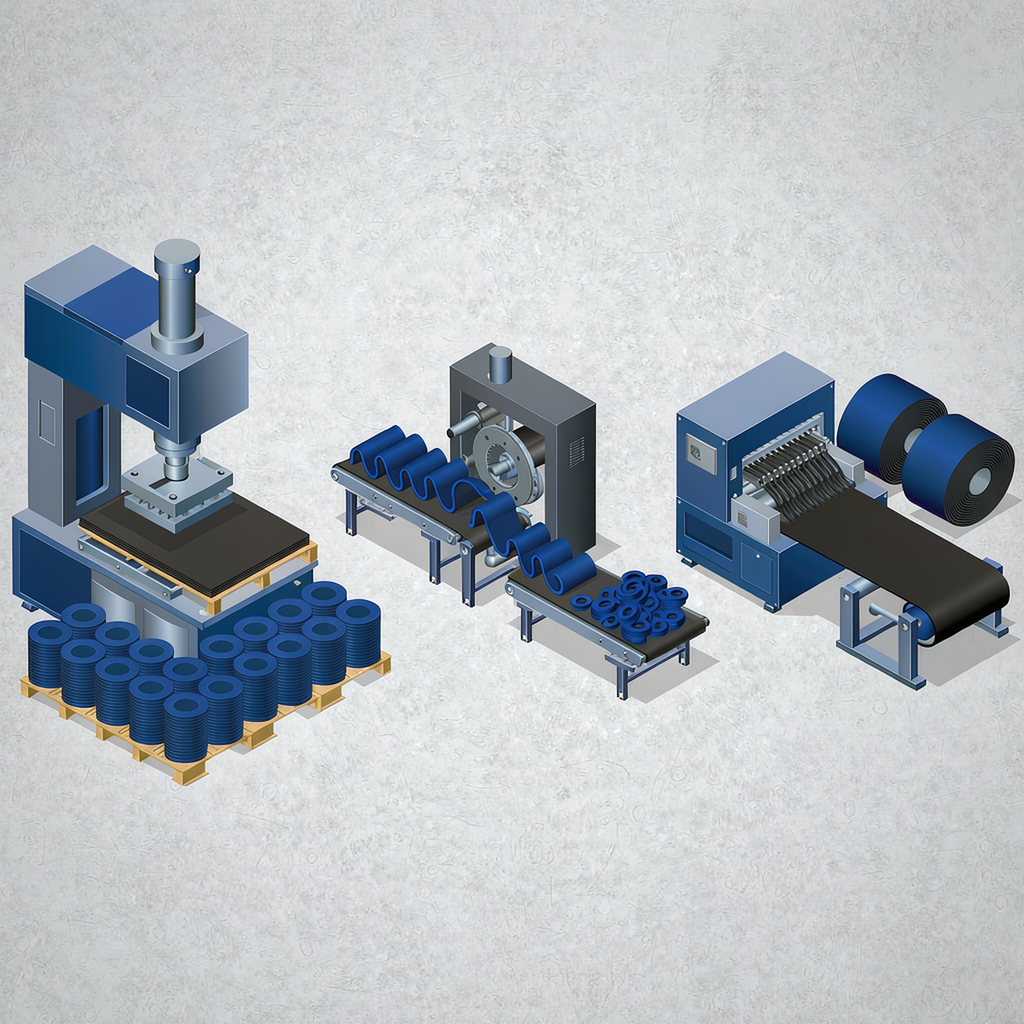
How Do Die Cutting, CNC Cutting, and Slitting Compare?
Across five measurable dimensions — tolerance, speed, thickness range, tooling, and batch economics — no single method dominates all five. The table below is the short version; our own machines supply the CNC and slitting figures, while the die-cut and slitting tolerance bands are typical values from our experience.
| Comparison dimension | Die cutting | CNC cutting | Slitting |
|---|---|---|---|
| Achievable tolerance | ±0.25 mm on 3 mm sheet (typ.) | ≤±0.05 mm (servo ±0.01 mm + lead screw ±0.02 mm) | ±0.10 mm strip width (typ.) |
| Throughput | Multi-cavity press strokes; fastest per part at volume | 240 cuts/min dual axis = 14,400 pcs/h theoretical | 80 strokes/min |
| Part geometry covered | Flat gaskets, washers, sheet profiles | Tube Φ10–Φ180 mm, length ≤260 mm, rings and seals | Stock 600–1,000 mm wide, 0–20 mm thick, strips and rolls |
| Tooling and changeover | One die per profile, ~3–5 weeks lead time (typ.) | No die; program change under 15 min (typ.) | Blade spacing change; carbide round cutter ø60/ø80 mm |
| Batch economics | Pays back above ~5,000 pcs per profile (typ.) | Wins from 1 piece to ~5,000 pcs | Economical for continuous roll-length runs |
| Power and footprint | Hydraulic press, high installed power | 3 kW on AC220 V; 1,300 × 900 × 1,600 mm; 510 kg | 1.5–2.5 kW; 1,100–1,500 × 1,400 × 1,200 mm |
Machine parameters are current Xingchangjia specifications verified 2026-09-21. Rows marked (typ.) are typical values from our experience across customer cutting projects.
Where Does Each Method Actually Win?
Die cutting wins on unit cost at volume, because the tooling cost is fixed and therefore falls to almost nothing per part as volume rises. Its weakness is simple: a die cannot be reprogrammed, so design changes cost money and five weeks instead of minutes.
CNC cutting wins on accuracy and flexibility, because closed-loop servo positioning removes the tooling wear that limits die cutting. That is why our rotary machine holds ≤±0.05 mm and covers tube from Φ10 mm to Φ180 mm; a shop that runs fifty ring profiles a month can serve all of them from one 3 kW machine on a 220 V supply.
Slitting wins whenever the product is a strip rather than a discrete part, because continuous feeding converts cutting into a line-speed problem instead of a per-piece problem. Our strip machines cover 600 mm, 800 mm, and 1,000 mm widths at 80 strokes per minute through 0–20 mm thickness, and they are the only sensible option once you are buying sheet in roll form.
Field note on accuracy claims
Ask any cutting supplier what test conditions produced their tolerance figure. Dimensional tolerances for rubber are only meaningful against a defined class and method — that is exactly what ISO 3302-1:2014 exists to define for moulded, extruded, and calendared rubber products.
Which Method Fits Your Part?
Match the method to the geometry first, because geometry decides which methods can meet your drawing at all. Open the selector below and find the shape closest to your part.
Flat gasket, washer, or sheet profile
Die cutting first, then CNC. Above 5,000 pieces per profile die cutting costs roughly 20–30% less per part because the die is amortised (typical values from our experience); below that volume CNC is cheaper, because there is no die to buy.
Ring or seal cut from extruded tube
Long strip or roll of constant width
Weight-critical blank for compression moulding
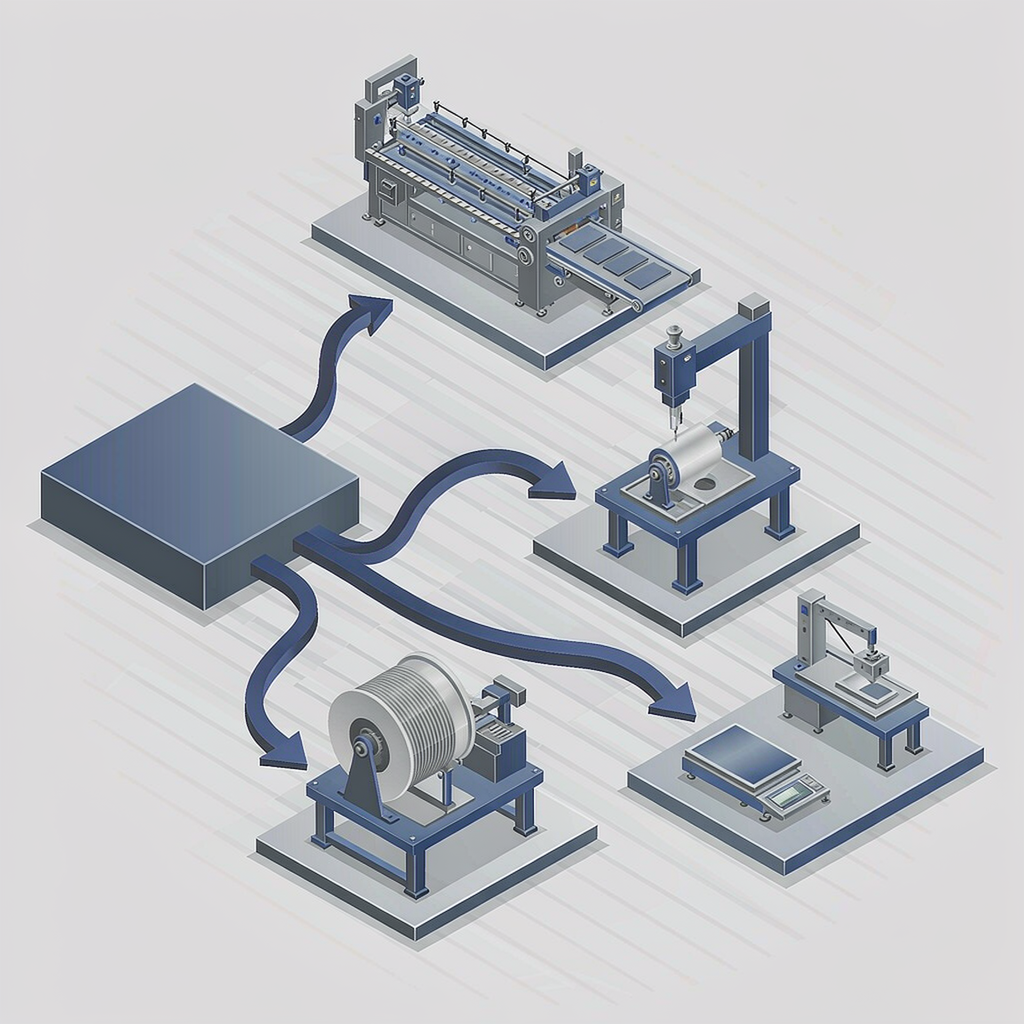
What Does Accuracy Really Cost?
Closed-loop CNC cutting costs more per machine than die cutting but less per design change, because you buy positioning accuracy once instead of buying a new die per profile. A die is a fixed investment in one geometry; a servo axis is a reusable investment in all of them.
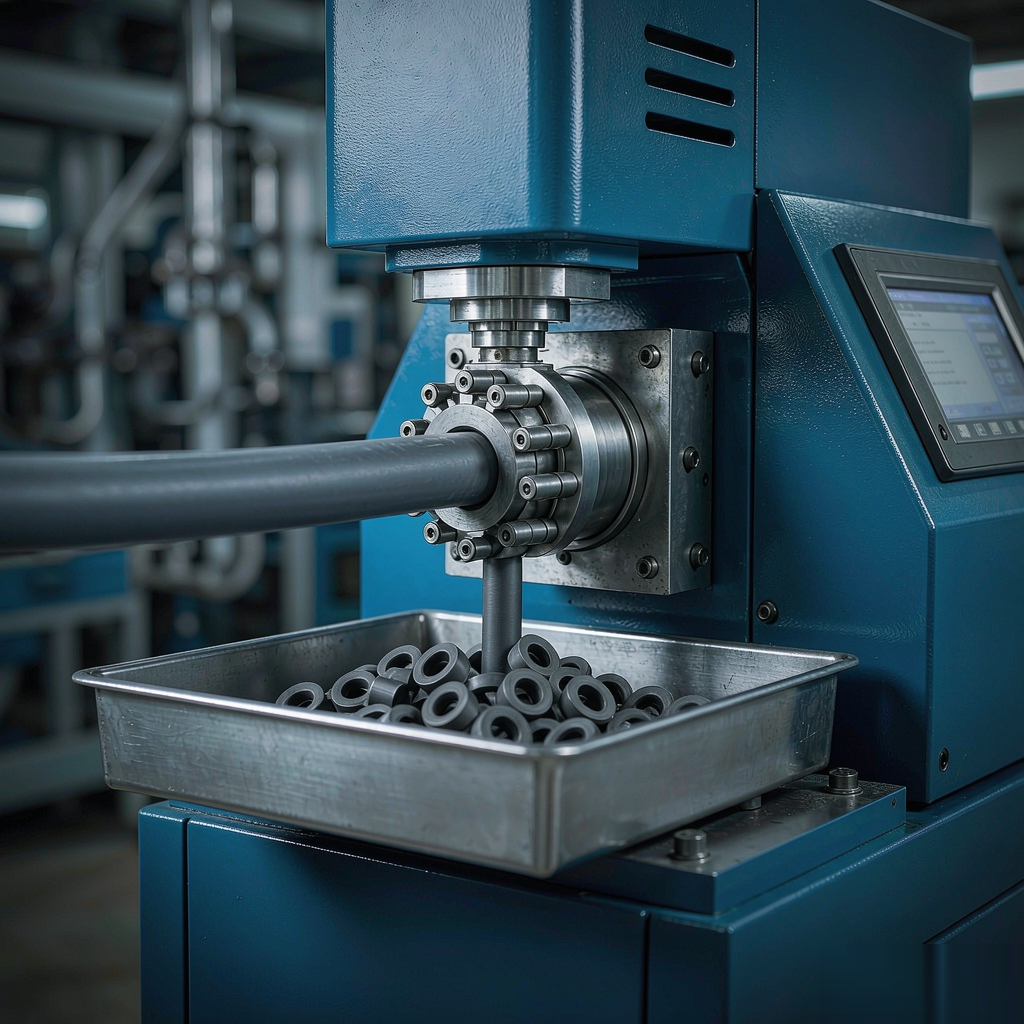
There is also a materials side to the accuracy question. Rubber hardness and heat-ageing behaviour set how much a cut part can move after cutting, and those are specified rather than guessed — ASTM D2000 limits tensile change to ±30% and hardness change to ±15 points after 70 hours of heat ageing, which is the kind of tolerance stack a cutting method cannot rescue.
Which One Should You Choose?
Choose die cutting when a single flat profile exceeds roughly 5,000 pieces per run, the drawing is frozen, and unit cost matters more than changeover. Choose CNC cutting when your part is a ring or tube section, or when drawings still change. Choose slitting when the deliverable is a strip or roll rather than a discrete part.
And the honest counter-case: do not buy a die for a profile you have not yet sold twice, and do not buy a rotary CNC machine if every order is 600 mm wide sheet — slitting plus a simple guillotine will out-earn a more accurate machine that spends its life idle. Rubber is unforgiving about idle capital.
Conclusion: Screen by Geometry, Then Buy by Volume
The three rubber cutting methods are not competitors so much as three different answers to three different shapes. Die cutting converts volume into low unit cost, CNC cutting converts programmability into accuracy and flexibility, and slitting converts continuous feed into high strip throughput. Because your drawing decides which of the three can hold tolerance at all, the correct sequence is geometry, then tolerance, then break-even volume.
Send us your part drawing, material, and monthly volume and we will tell you which method fits — including when the honest answer is that you do not need a new machine. Our cutting range covers rubber cutting machines for all three methods, and our engineers will quote against your actual geometry rather than a catalogue average. Certificates are available for our quality system, which is maintained to ISO 9001.
Related Equipment Information
• Rubber gasket cutting machine XCJ-QGJ2-180#: ≤±0.05 mm accuracy, 240 cuts/min on Φ10–Φ180 mm tube.
• CNC rubber strip cutting machine: 600/800/1,000 mm widths, 0–20 mm thickness, 80 strokes/min.
• Automatic weight cutting machine: screen-set tolerance bands with automatic accept/reject weighing.
• Rubber slitter cutting machine: adjustable blade position for consistent strip widths.
• Fully automatic silicone cutting machine: continuous cutting for silicone profiles and strip.
• Rubber deflashing machines: the next station after cutting when flash removal is required.
Frequently Asked Questions: Rubber Cutting Methods
Xiamen Xingchangjia Non-Standard Automation Equipment Co., Ltd.
Floor1, Building 13, Huli Industrial Park, Meixidao, Tongan, Xiamen China
Email: info@xcjrubber.com | Website: www.xmxcjrubber.com
Published: September 2026 | Last verified: 2026-09-21
Post time: Sep-21-2026