




By Mike Chen, Production Director | 12+ Years in Rubber Manufacturing | LinkedIn
Key Takeaways
- · Mechanical deflashing costs 40–60% less to operate but delivers lower precision on complex flash geometries.
- · Cryogenic deflashing handles thin flash (under 0.3 mm) better and preserves surface finish on delicate parts.
- · High-volume O-ring production favors mechanical; precision medical or aerospace parts require cryogenic.
- · Equipment selection depends on part geometry, material properties, production volume, and acceptable per-part cost.
The short answer: The choice depends on part characteristics and production priorities. Mechanical deflashing offers faster cycle times and lower operating costs for standard rubber parts with thicker flash. Cryogenic deflashing achieves superior precision for thin-flash components, complex geometries, and temperature-sensitive materials.
This comparison examines five critical dimensions—precision, operating cost, cycle time, material compatibility, and equipment investment—to help manufacturers match deflashing technology to their specific requirements. By the end, you will have a clear framework for deciding which technology fits your production environment and quality standards.
Cryogenic vs Mechanical Deflashing: Working Principles Compared
Understanding the fundamental operating principles of each technology explains why they produce different results for different part types.
Cryogenic deflashing uses controlled freezing to embrittle flash
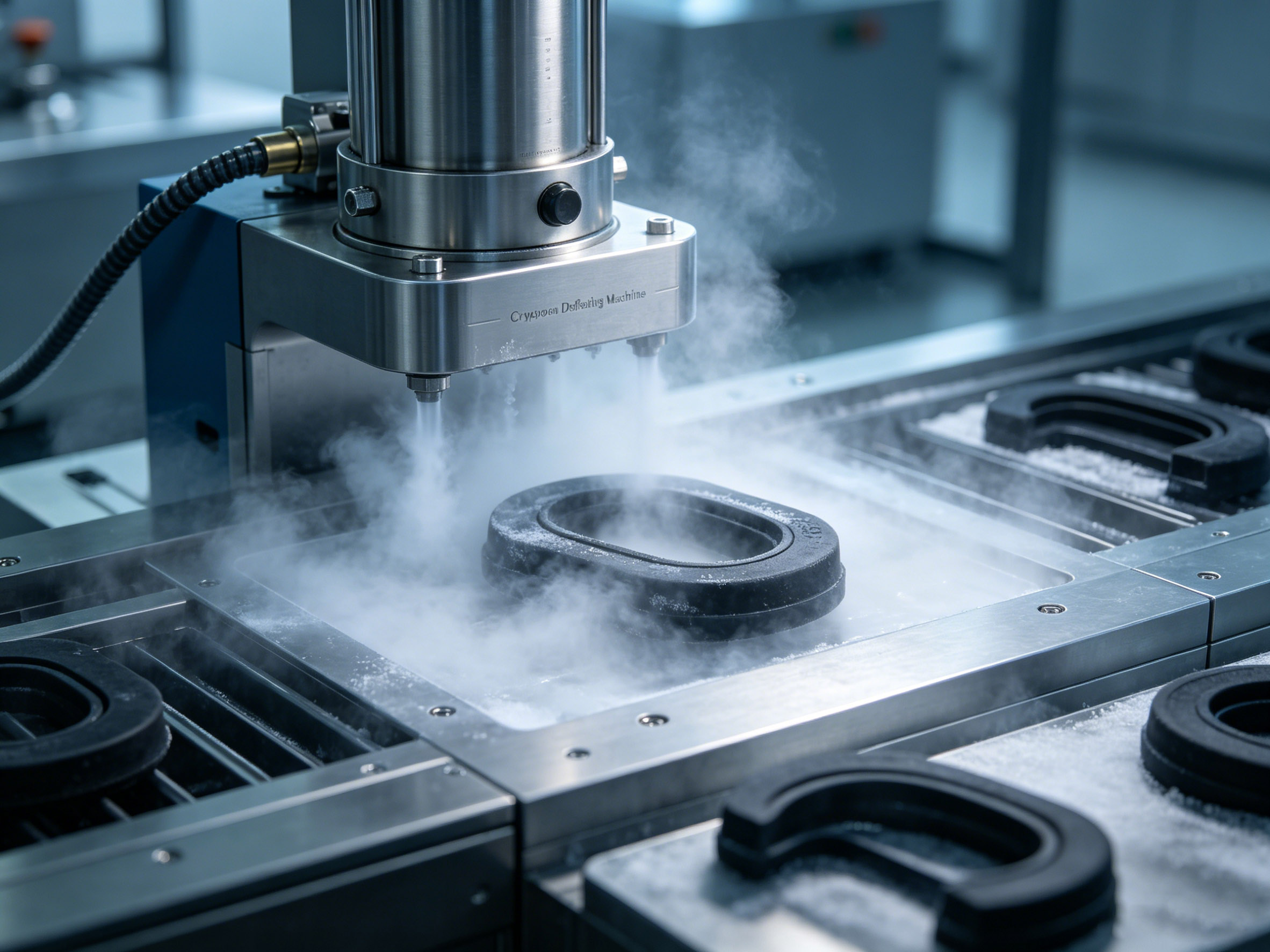
Cryogenic deflashing machines expose rubber parts to liquid nitrogen at temperatures between −100°C and −130°C. At these low temperatures, the thin flash material becomes brittle while the main part body retains its flexibility due to thermal mass differences. Blasting media then impacts the frozen parts, breaking off the embrittled flash without applying mechanical force to the base material.
Because the process relies on controlled temperature rather than abrasion, cryogenic deflashing preserves surface finish and maintains dimensional accuracy. The process is widely used for precision rubber components in automotive sealing, medical devices, and electronic applications where flash removal within 0.05 mm tolerance is required.
Mechanical deflashing uses aerodynamic force to remove flash
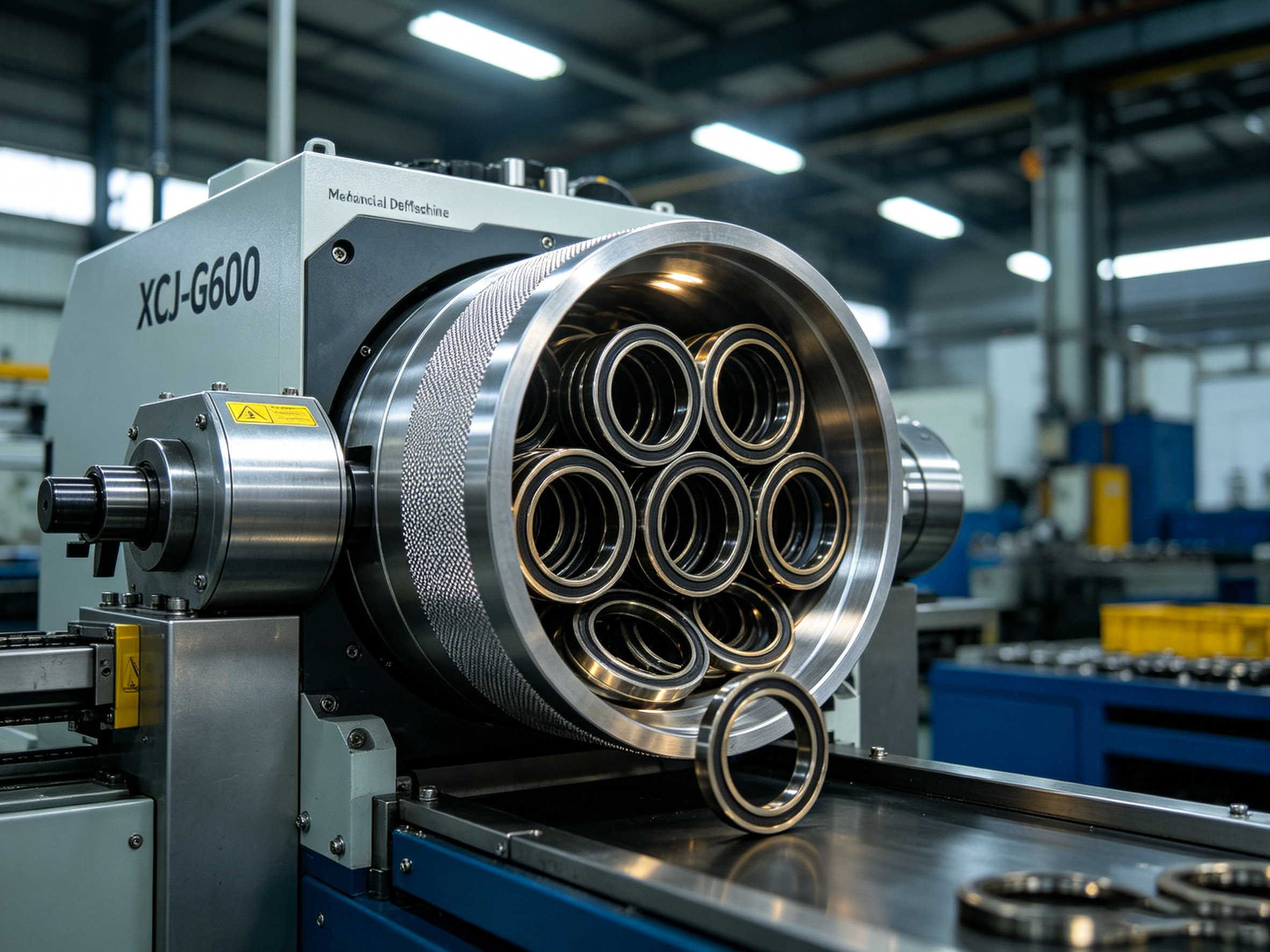
Mechanical deflashing machines operate on aerodynamic principles without freezing or liquid nitrogen. Parts tumble inside a rotating drum while high-velocity media or air streams abrade flash material from the surface. The XCJ-G600 super mechanical deflashing machine processes 15 kg batches of O-rings automatically, achieving per-piece cycle times of 20–40 seconds with a 7.5 kW drive system. A single mechanical deflashing unit replaces 40–50 manual workers in terms of production output.
Mechanical systems handle parts with outer diameters from 3 mm to 100 mm with no product line diameter restriction, making them versatile for mixed-production environments. The aerodynamic principle means no liquid nitrogen is required, reducing consumable costs significantly.
Cryogenic vs Mechanical Deflashing: Five Key Comparison Dimensions
| Comparison Dimension | Cryogenic Deflashing | Mechanical Deflashing |
| Operating Cost Per Part | Higher — liquid nitrogen at $0.15–0.30/kg adds $5–15 per batch | Lower — no consumable coolant; media costs $0.50–2.00 per batch |
| Cycle Time Per Batch | 10–20 minutes including freeze and blast cycles | 20–40 seconds per part, continuous batch processing |
| Flash Thickness Range | Excels at thin flash under 0.3 mm | Effective on flash 0.2 mm to 2.0 mm and thicker |
| Surface Finish Preservation | Superior — no mechanical abrasion on base material | Good — adjustable parameter control minimizes marking |
| Equipment Investment | $50,000–$200,000+ including nitrogen delivery system | $15,000–$80,000 depending on automation level |
Cost estimates based on standard industrial-grade equipment configurations and 2026 market pricing. Actual figures vary by supplier and geographic region.
Cryogenic Deflashing Machine Precision vs Mechanical Accuracy
Cryogenic deflashing costs approximately 3–5 times more per part than mechanical deflashing on standard rubber components, primarily because of the liquid nitrogen consumption required for each processing cycle. A typical cryogenic batch processing 15–30 kg of parts uses 20–50 kg of nitrogen at $0.15–0.30 per kilogram.
Mechanical deflashing costs significantly less per part because the primary consumable is abrasive media, which lasts multiple cycles before replacement. For high-volume O-ring production, mechanical deflashing achieves per-part costs that are 60–80% lower than equivalent cryogenic processing.
The precision advantage of cryogenic deflashing becomes critical for parts requiring flash removal within 0.05 mm tolerance. Mechanical deflashing achieves adequate results for parts with Class B flash tolerance (up to 0.2 mm remaining flash accepted in non-sealing areas).
Rubber Deflashing Technology Selection: Application-Based Guidance
The decision framework below matches deflashing technology to common manufacturing scenarios.
Choose mechanical deflashing when these conditions apply
Mechanical deflashing works better for high-volume production of standard rubber parts. Applications producing 50,000+ O-rings or seals per day benefit from the 20–40 second per-part cycle time and lower consumable costs. Mechanical systems are particularly effective for EPDM, NBR, and natural rubber compounds where flash thickness exceeds 0.2 mm.
The XCJ-G600 mechanical deflashing machine demonstrates this advantage clearly: one unit replaces 40–50 manual workers while processing parts from 3 mm to 100 mm outer diameter. The 7.5 kW motor and automatic feeding mechanism enable continuous operation with minimal operator attention.
Choose cryogenic deflashing when precision requirements are higher
Cryogenic deflashing is the better option for silicone, FKM, and medical-grade elastomers where surface finish preservation is critical. Parts with flash thickness below 0.3 mm respond poorly to mechanical abrasion because the thin flash flexes rather than fractures. Cryogenic processing embrittles this thin flash reliably, enabling complete removal without dimensional alteration.
Industries requiring cryogenic deflashing include medical device manufacturing (FDA-compliant silicone parts), aerospace sealing components, and precision electronic enclosures. These applications justify the higher per-part cost through reduced rejection rates and consistent quality.
Situations where neither technology is a perfect fit
Some applications fall between these categories. Parts with mixed flash profiles—some areas thick, some paper-thin—may require sequential processing: mechanical deflashing for bulk removal followed by cryogenic finishing for precision areas. Manufacturers facing this scenario should evaluate whether a single technology with adjustable parameters meets their quality standards or if dual-system investment is justified by production volume.
Material Compatibility: Which Rubber Compounds Work Best with Each Method
Different elastomer compounds respond differently to deflashing methods. The table below summarizes compatibility based on common manufacturing experience.
| Rubber Compound | Mechanical Deflashing | Cryogenic Deflashing |
| EPDM | Excellent — handles abrasion well | Good — moderate precision improvement |
| NBR / Nitrile | Excellent — high throughput | Good — better for thin flash |
| Silicone | Fair — risk of surface damage | Excellent — preserves finish |
| FKM / Fluoroelastomer | Fair — needs soft media | Excellent — consistent results |
| Natural Rubber | Excellent — standard choice | Good — when precision required |
ISO 1629 establishes the nomenclature system for rubber and latex materials, providing standardized material identification across global supply chains.
Cryogenic Deflashing Machine Cost: Operating Expenses per Production Shift
OSHA safety guidelines for industrial equipment operation apply to both deflashing technologies. Mechanical deflashing systems require standard machine guarding per OSHA 1910.212, including interlocked access panels and emergency stop mechanisms. Cryogenic systems have additional safety requirements for liquid nitrogen handling, including ventilation monitoring, cryogenic glove use, and pressure relief systems.
For an 8-hour production shift processing 500 kg of rubber parts, mechanical deflashing operating costs typically run $40–80 including media, electricity, and labor. Equivalent cryogenic processing costs $200–400 per shift due to nitrogen consumption of 150–300 kg. The 3–5× cost difference narrows for high-precision parts where mechanical rejection rates exceed 10%, making cryogenic the more economical choice when yield is factored in.
Which Deflashing Method Should You Choose?: Decision Framework
Choose mechanical deflashing when:
1. Production volume exceeds 10,000 parts per day
2. Parts have flash thickness above 0.2 mm
3. Operating cost per part is the primary constraint
4. Material is EPDM, NBR, or natural rubber
5. Part surface finish requirements are Class B or below
Choose cryogenic deflashing when:
1. Parts require zero visible flash under 10× magnification
2. Flash thickness is consistently below 0.3 mm
3. Material is silicone, FKM, or other high-performance elastomer
4. Surface finish integrity is critical (medical, aerospace)
5. Per-part quality consistency justifies higher operating cost
Conclusion: Matching Deflashing Technology to Production Requirements
Cryogenic and mechanical deflashing technologies serve different segments of the rubber manufacturing market. Mechanical deflashing delivers the lowest per-part cost for high-volume production of standard rubber components. Cryogenic deflashing provides superior precision and surface preservation for parts where quality requirements justify higher processing costs.
Neither technology is universally better. The correct choice depends on part geometry, material type, flash characteristics, production volume, and quality standards. Manufacturers processing a wide range of products may benefit from maintaining both capabilities.
Related Equipment Information
• Review rubber deflashing machine (XCJ-G600) specifications for mechanical deflashing applications.
• Explore cryogenic deflashing machine capabilities for precision rubber components.
• See complete rubber processing equipment options for integrated production lines.
• View rubber gasket cutting machines for downstream processing.
Frequently Asked Questions: Cryogenic vs Mechanical Deflashing
What is the main difference between cryogenic and mechanical deflashing?
Cryogenic deflashing freezes rubber parts with liquid nitrogen to make flash brittle, then uses blasting media to break it off. Mechanical deflashing uses aerodynamic force or tumbling action at ambient temperature to abrade flash away. The cryogenic method costs 3–5× more per part but achieves higher precision on thin-flash components.
Which deflashing method is faster for high-volume O-ring production?
Mechanical deflashing is significantly faster for standard O-ring production. The XCJ-G600 processes each O-ring in 20–40 seconds and handles 15 kg batches continuously. Cryogenic deflashing requires 10–20 minutes per batch including freeze and blast cycles, making it slower unless precision requirements eliminate mechanical as an option.
Can a mechanical deflashing machine process silicone rubber parts?
Mechanical machines can process silicone parts, but parameters must be carefully adjusted. Silicone’s lower tear strength makes it susceptible to surface damage from aggressive media. Using softer blast media, reducing tumbling speed, and shortening cycle time improves results. For thin-flash silicone components, cryogenic deflashing generally produces superior surface finish.
What safety precautions are required for cryogenic deflashing operations?
Cryogenic deflashing requires oxygen deficiency monitoring because liquid nitrogen displaces air in enclosed spaces. Operators need cryogenic-rated gloves, face shields, and insulated aprons. Pressure relief systems must be verified regularly. Mechanical deflashing requires standard machine guarding per OSHA 1910.212 with interlocked access panels and emergency stop controls.
How do I calculate the payback period for each deflashing technology?
Calculate daily operating cost including consumables, energy, and labor, then compare to current manual deflashing cost. A mechanical machine replacing 5 manual workers ($40,000/year each) typically pays back in 8–14 months. Cryogenic systems pay back in 12–24 months when replacing manual operations on precision parts where rejection rates exceed 15%.
Can one deflashing machine handle both thick and thin flash on different parts?
Mechanical deflashing with adjustable parameters handles flash thickness from 0.2 mm to 2.0 mm by varying tumbling speed, media type, and cycle duration. Cryogenic deflashing handles flash from 0.05 mm to 0.5 mm by adjusting temperature and media impact energy. Parts with mixed thick and thin flash profiles may require sequential processing using both technologies for optimal results.
Xiamen Xingchangjia Non-Standard Automation Equipment Co., Ltd.
Floor1, Building 13, Huli Industrial Park, Meixidao, Tongan, Xiamen China
Email: info@xcjrubber.com | Website: www.xmxcjrubber.com
Published: June 2026
Post time: Jun-09-2026