




You might already know that raw material costs account for the bulk of your production budget.
But are you aware of how much of that investment is silently bleeding out through “acceptable” scrap rates?
As a manufacturer, I know the frustration of watching expensive rubber compound turn into waste during edge trimming and changeovers. The reality is, relying on manual calibration or standard, off-the-shelf cutters is costing you money.
In this post, you’re going to learn exactly how Smart Slitters are replacing manual guesswork and Boosting Material Yield by 15%.
We will break down the engineering behind Xiamen Xingchangjia Non-standard Automation Equipment and show you why custom, data-driven solutions are the only way to truly Stop Wasting Rubber.
Let’s get to the numbers.
Anatomy of a “Smart” Slitter: Beyond the Standard Cutter
We need to stop viewing slitting as a passive, secondary process. A standard industrial rubber cutter relies on manual setups and static mechanics—it cuts where you tell it to, regardless of how the material behaves. In contrast, modern elastomer web slitting systems are active participants in your production line. A “smart” slitter integrates PLC controls with sensor feedback loops, transforming a dumb blade into an intelligent yield-management tool. It doesn’t just cut; it reads, reacts, and adjusts millisecond-by-millisecond.
Real-Time Edge Detection: Slicing Trim Waste
The fastest way to bleed profit is through conservative edge trimming. Operators typically set a 15mm safety margin to account for web wander, sacrificing perfectly good rubber just to be safe. We eliminate that guesswork with edge trim reduction technology.
By utilizing optical sensors and precision web guiding, our systems track the material edge in real-time. The machine dynamically adjusts the blade positioning to follow the web’s actual path, not a theoretical straight line.
- Standard Manual Setup: ~15mm trim waste per side.
- Smart Edge Detection: ~2mm trim waste per side.
That is an immediate reduction in scrap that goes straight to your bottom line.
Tension Control Algorithms for Material Stability
Rubber isn’t paper; it fights back. If you apply too much torque, the elastomer stretches and narrows (necking). You might cut it at the correct width while under tension, but the moment it relaxes on the rewind, it snaps back to the wrong dimension.
Tension control in rubber processing is non-negotiable for dimensional accuracy. Our smart slitters utilize closed-loop algorithms that monitor torque and speed simultaneously. This prevents material deformation correction errors by maintaining consistent, ultra-low tension throughout the cut. We ensure the rubber web slitting system delivers a final roll that matches the spec exactly—not just when it’s under stress.
The Math Behind the 15% Yield Boost
When I claim we can Stop Wasting Rubber: How Smart Slitters are Boosting Material Yield by 15%, I am not guessing. This figure comes from attacking waste at three specific points in the production line where standard machines bleed money. We achieve substantial rubber manufacturing yield improvement by replacing manual guesswork with precision engineering.
Here is exactly how the numbers stack up:
- Trim Optimization (5-7%): In traditional setups, operators leave wide safety margins because the web wanders. By utilizing edge trim reduction technology and precision web guiding, we don’t have to play it safe. Dynamic blade positioning tracks the material edge in real-time, allowing us to shave trim waste from a standard 15mm down to a tight 2mm.
- Changeover Efficiency (3-5%): Manual blade setting is a killer for scrap rate optimization. Usually, you have to run (and waste) several meters of expensive rubber just to verify the cut width. With automated blade positioning, the knives lock into the exact coordinates before the line moves. This eliminates setup scrap entirely.
- Defect Avoidance (2-3%): Blind cutting processes bad material, which wastes energy and downstream labor. Our systems use real-time slitting analytics to identify upstream defects. The machine automatically adjusts to skip bad sections, ensuring you only process quality elastomers.
By integrating these non-standard automation solutions, we turn what used to be unavoidable process waste into usable product.
Why Standard Machines Fail
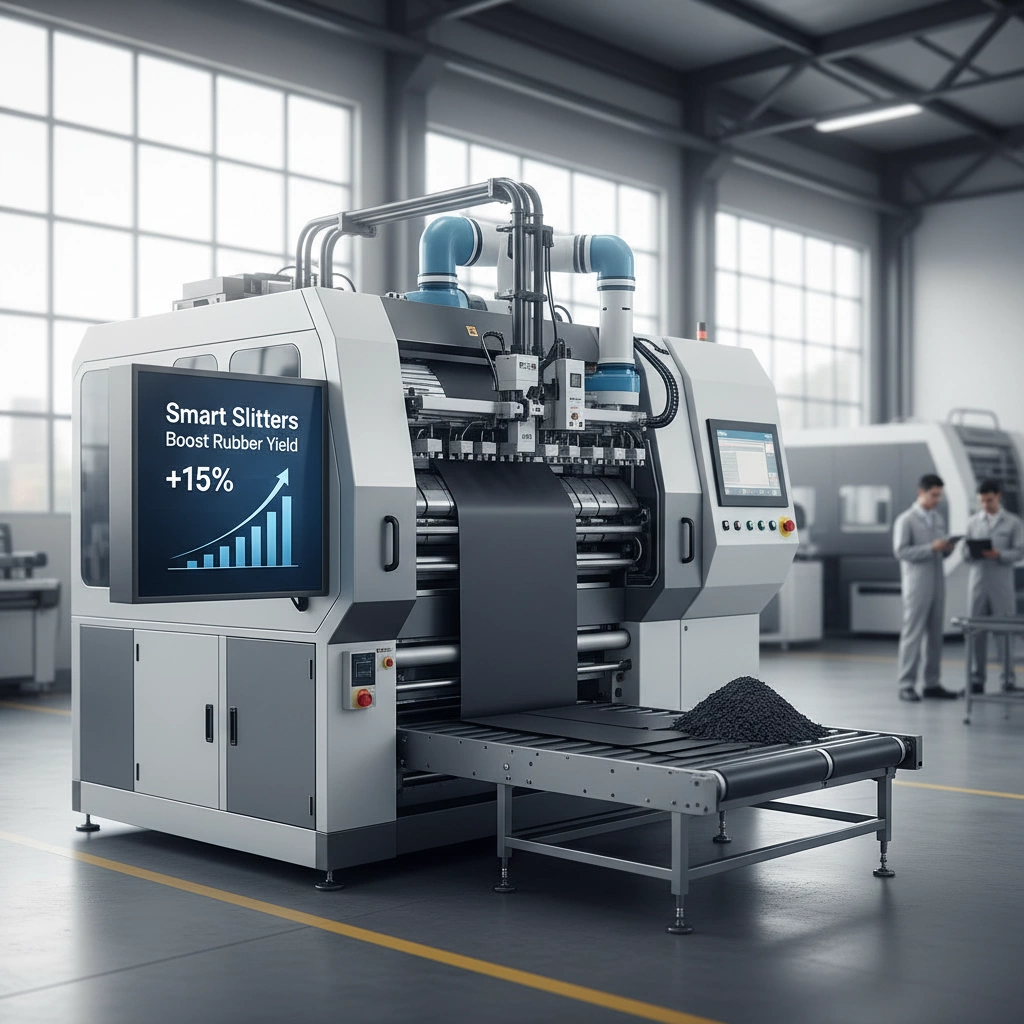
Most off-the-shelf equipment is designed for rigid materials like paper or foil, not the unpredictable nature of elastomers. When you try to force a general-purpose machine to handle complex rubber profiles, you end up with stretched material and inconsistent widths. To Stop Wasting Rubber: How Smart Slitters are Boosting Material Yield by 15%, you have to acknowledge that standard gear simply lacks the sensory feedback required for soft materials.
Rubber Variability Challenges
Rubber isn’t just one material; it’s a spectrum of behaviors. A standard Industrial rubber cutter often treats EPDM the same way it treats Natural Rubber, which is a recipe for disaster.
- EPDM: Often tough and resistant, requiring higher blade pressure that standard holders can’t maintain.
- Silicone: High friction and elasticity mean it stretches easily. Without material deformation correction, you get “necking,” where the cut width shrinks after tension is released.
- Natural Rubber: varying tackiness can gum up standard blades, leading to jagged edges.
Elastomer web slitting systems need to adapt torque and tension dynamically. If your machine can’t tell the difference between a 40 Shore A silicone and a 70 Shore A Viton, you are guaranteed to generate scrap.
The Custom Advantage of Non-Standard Automation
This is why we lean heavily into Non-standard automation solutions. A generic machine offers a “best guess” setting, whereas custom automation is built around your specific compound’s rheology.
- Tailored Tension Zones: We isolate tension zones to ensure the rubber is relaxed exactly when the blade hits it.
- Specific Blade Geometry: Custom setups allow for rotary shear slitting angles that standard cartridges don’t support.
By using a purpose-built Rubber Slitter cutting machine, we eliminate the “fighting” between the machine and the material.
Integration of Custom Machines into Legacy Production Lines
A major hesitation I hear from US plant managers is the fear of ripping out existing infrastructure. The beauty of modern Rubber web slitting systems is their modularity. We don’t need to replace your entire extrusion line.
- Retrofit Ready: Smart slitters can be dropped in as a replacement for the final cutting station on legacy lines.
- Seamless Handshake: Modern PLCs easily communicate with older upstream equipment to synchronize line speeds.
You get the benefit of Real-time slitting analytics and precision cutting without the capital expense of a full floor overhaul.
Smart Analytics & Predictive Maintenance
A modern rubber web slitting system does a lot more than just cut; it communicates. We design these machines to act as critical nodes in your smart factory rubber extrusion line, turning raw data into actionable insights that protect your bottom line.
Data Feeding to MES Systems
We don’t believe in tracking production with clipboards. Our smart slitters integrate directly with your Manufacturing Execution System (MES). This connection provides real-time slitting analytics on production speed, tension variances, and scrap rates. You get a clear, instant picture of your floor’s efficiency without relying on manual data entry, ensuring your industrial rubber cutter is always operating at peak performance.
Blade Life Management with Sensors
Nothing kills yield faster than a dull blade tearing through expensive EPDM or silicone. We utilize advanced sensors to monitor blade sharpness and vibration signatures.
- Predictive Alerts: The system notifies operators exactly when a blade needs changing, preventing jagged cuts before they happen.
- Optimized Uptime: Maintenance becomes planned rather than reactive, keeping the line moving.
Traceability for Yield and Vendor Material Quality
As a custom automation equipment manufacturer, we know that sometimes the issue isn’t the machine—it’s the material. By tracking yield data per master roll, we create a digital paper trail. You can instantly identify if a specific vendor is supplying inconsistent rubber, giving you the data-backed leverage to demand better quality or switch suppliers.
Implementation Strategy: Upgrading to Smart Slitters
Transitioning from manual cutting to a fully automated Rubber web slitting system isn’t just about buying new hardware; it is about changing how you view material value. We see too many factories in the States running legacy equipment that bleeds profit through excessive trim and downtime. To get that 15% yield boost, you need a deliberate implementation plan that starts with hard data and ends with the right partnership.
Assessing Your Current Scrap Rate
You cannot fix what you do not measure. Before looking at specs, walk your production floor. The first step in scrap rate optimization is identifying exactly where the rubber is going. In manual setups, operators often overestimate their efficiency.
Look for these specific waste generators:
- Edge Trim: Measure the actual width of the waste strips. If you are tossing more than 5mm per side, you are losing money.
- Setup Waste: Count the yards of material used for test cuts every time the blades are repositioned.
- Roll End Loss: Calculate how much material is left on the core because the machine lacks precise tension control near the end of the roll.
If you are relying on handwritten logs, you are likely underestimating waste by 20%. A Rubber Slitter cutting machine with integrated sensors removes this guesswork, but you need a baseline audit first to validate the upgrade.
ROI Calculation Formula for Payback Period
To justify the investment to stakeholders, you need a clear Industrial rubber cutter ROI calculation. The payback on smart slitters usually comes faster from material savings than labor reduction.
Use this formula to estimate your payback period:
- Calculate Material Savings: (Current Monthly Scrap Weight – Projected Smart Scrap Weight) × Material Cost per Lb.
- Calculate Downtime Savings: (Hours spent on manual blade setup × Hourly Operation Cost).
- Total Monthly Benefit: Material Savings + Downtime Savings.
- Payback Period: Total Machine Cost / Total Monthly Benefit.
With real-time slitting analytics, we typically see US manufacturers achieve a payback period of 12 to 14 months. The ability to save 3-5% on edge trim alone often covers the financing payments for the equipment.
Choosing a Non-Standard Automation Partner
Standard catalog machines are built for paper or film, not for the complex rheology of cured rubber. When dealing with EPDM, silicone, or natural rubber, off-the-shelf equipment often fails to account for material stretch and recovery. This is where non-standard automation solutions become essential.
When vetting a custom automation equipment manufacturer, look for these qualifications:
- Material Expertise: Do they understand how different elastomers react to shear force?
- Software Flexibility: Can their PLC logic adapt to your specific batch variances?
- Integration Capability: Can they retrofit the slitter into your existing extrusion or calendering line?
Your partner should be building the machine around your material, not forcing your material to fit a standard machine. This tailored approach is the only way to ensure the yield improvements you calculated in the ROI phase actually happen on the floor.
Common Questions on Smart Rubber Slitting
Smart Slitter vs. Standard Industrial Rubber Cutter
A standard industrial rubber cutter is essentially a fixed mechanical tool—you set the blades manually, run the material, and hope for the best. It cuts blindly. A smart slitter, however, uses automated blade positioning and sensors to “see” the material. It constantly adjusts to variations in the rubber web. While a standard machine requires downtime for every width change, a smart rubber slitter cutting machine handles adjustments instantly, drastically reducing the setup scrap that kills profit margins.
The Role of Tension Control in Rubber Processing
Rubber is tricky because it stretches. If your tension is too high during cutting, the material narrows (necks down). Once it relaxes on the spool, it expands back, and your width is suddenly out of spec. Tension control in rubber processing solves this by using algorithms to maintain the exact force needed to keep the web flat without deforming it. This ensures that the cut width remains accurate even after the elastomer web slitting systems have finished the job.
Is the 15% Yield Improvement Realistic?
The concept of “Stop Wasting Rubber: How Smart Slitters are Boosting Material Yield by 15%” is based on tangible data, not just optimism. When you combine edge trim reduction technology (cutting trim from 15mm down to 2mm) with the elimination of setup waste, hitting a 15% improvement is a standard benchmark for factories moving from manual to automated systems. For operations with high scrap rate optimization needs, the gains can be even higher.
Retrofitting Non-Standard Automation Solutions
Many facility managers worry that new tech won’t play nice with old machines. This is where non-standard automation solutions shine. Unlike off-the-shelf catalog machines, we design these units to fit into your specific legacy lines. As a custom automation equipment manufacturer, we build the integration points to match your existing upstream extruders and downstream winders, ensuring a seamless upgrade without ripping out your entire floor.
Key Metrics in Real-Time Slitting Analytics
To drive true rubber manufacturing yield improvement, you need to track the right data. Our systems focus on feeding the following points to your MES:
- Blade Life: Predictive sensors tell you when to change blades before they cause jagged edges.
- Trim Width: Monitors exactly how much waste is being generated per run.
- Tension Variance: Alerts operators if the web is being stretched beyond tolerance.
- Defect Mapping: Logs the location of bad material so it can be removed automatically.
Post time: Jan-27-2026