




Author: Xiamen Xingchangjia Non-standard Automation Equipment Co., Ltd.
Rubber deflashing, cutting and automation equipment manufacturer | ISO 9001 | Exports to 15+ countries
Key Takeaways
- Track blade life in cut-edge meters, not calendar weeks: two plants running the same machine differ by 3x purely on compound.
- A 0.35 mm carbide disc on a gasket cutter holds 120–400 blade-hours; a bevel shear knife on a strip cutter holds 500–900 blade-hours.
- Most “worn” blades we inspect are misaligned blades — check the holder before spending money on a new edge.
- Set the first scheduled change at 80% of the interval that produced the first bad cut, then adjust in ±20% steps.
The short answer: a rubber cutting machine blade replacement schedule should be driven by cut-edge volume, not by the calendar. On a gasket cutter running a 0.35 mm carbide disc, expect 120–400 blade-hours depending on compound; on a bevel shear knife cutting 0–20 mm sheet at 80 strokes per minute, expect 500–900 blade-hours. Record the interval that produced the first out-of-tolerance part, then set your fixed change point at 80% of that number.
Most cutting machines arrive with a manual that says “replace the blade when worn”. That sentence is useless on a shop floor, because a blade does not announce itself: it rounds over by a few hundredths of a millimeter, the cut face smears, and the first obvious symptom is a rejected batch.
This guide covers the three wear modes, the blade specifications our machines carry, and a five-step routine that turns them into an operator-ready schedule.
How Often Should You Replace a Rubber Cutting Machine Blade?
Replace on accumulated cut-edge volume with a material factor applied, and treat hours as a fallback only when the machine runs one compound at one speed. The table below pairs the blade geometry published for our rubber cutting machine range with the edge life we see in the field.
| Machine | Blade specification | Thickness range | Rated speed | Practical edge life* |
|---|---|---|---|---|
| Gasket cutting machine XCJ-QGJ2-180# | Carbide disc ø60 × ø25.4 × 0.35 mm (below 10 mm); ø80 × ø25.4 × 0.65 mm (10–20 mm) | 1–20 mm | 240 cuts/min (double axis) | 120–400 blade-hours |
| CNC strip cutting machine | Bevel-geometry shear knife, special steel | 0–20 mm | 80 cuts/min | 500–900 blade-hours |
| Fully automatic silicone cutting machine | 550 mm straight blade | 0–10 mm | 0–120 knives/min | 200–450 blade-hours |
| Automatic weight cutting machine XCJ-A600 | White steel knife, 550 mm actual cut width | Weight-based | Per mould count | 300–500 blade-hours |
Blade geometry and speeds are published specifications; edge life ranges are typical values from our experience.
Hours are only a fallback because they hide the two variables that consume an edge: meters of rubber past the blade, and how abrasive that rubber is.
Why Does a Blade Fail Before It Looks Broken?
Because the failure that matters is geometric, not structural. A cutting edge rarely snaps. It develops an edge radius, and once that radius approaches the sheet thickness divided by ten, the blade stops cutting and starts pushing.
- Edge rounding. Abrasive filler particles polish the edge into a curve. Cut force climbs, the face smears, and dimension drifts outward. This is the normal end of life.
- Micro-chipping. Hard agglomerates, frozen stock or a double feed knock fragments out of the edge. You see one-sided whiskers rather than a uniform burr.
- Clearance loss. The blade is still sharp, but the holder moved, the clamp bolt relaxed or the linear guide picked up rubber dust. This reads as wear and is not.
Check the holder before you change the blade
Check blade squareness to the anvil and clamp torque before any change. On the strip cutter the knife-edge sensor alarms on a missing edge but not on a tilted one.
What Is the Right Unit for Tracking Blade Wear?
Use cut-edge meters with a compound factor, which we call blade wear units. One blade wear unit equals 1,000 meters of cut edge through 70 Shore A carbon-black NBR; every other compound is expressed relative to that.
| Compound at the blade | Wear factor | Why it behaves this way |
|---|---|---|
| Pure gum natural rubber, 40–50 Shore A | 0.8 | Low filler load, edge stays polished |
| Carbon-black NBR, 70 Shore A | 1.0 | Reference compound |
| FKM | 1.2 | Hard but clean-cutting, little smearing |
| Mineral-filled EPDM | 1.6–2.0 | Hard filler particles act as a lapping compound |
| Silicone with fumed silica | 1.8–2.3 | Fine silica polishes the edge away |
| Sponge and low-density EPDM | 2.5+ | Material tears instead of shearing |
Factors are typical values from our experience across customer plants, cross-checked against Shore hardness measured to ASTM D2240. Above 80 Shore A, add a further 0.3.
Multiply logged cut-edge meters by the compound factor: a shift cutting 12,000 m of mineral-filled EPDM books 19,200–24,000 wear meters, so two materials on one machine share a single counter.
How Do You Build a Blade Schedule in Five Steps?
Run it backwards from a known bad cut. Take the interval that produced your last out-of-tolerance part and walk it back; do not start from a supplier’s suggestion.
- Log cut-edge meters per shift. Multiply pieces by cut length, or strokes by sheet width. At 240 cuts/min a 40 mm ring equals 5,760 m of edge per hour.
- Apply the compound factor. Convert the shift total into wear units so different materials accumulate on one counter.
- Set the first change point at 80% of the best-known life. If the last disc ran 320 blade-hours before parts drifted past ±0.05 mm, change at 256.
- Inspect at every change. Record edge condition, cut-face finish and servo current at a fixed reference setting.
- Adjust in ±20% steps only. Move one step per three consecutive changes; bigger jumps hide the cause.
Run this for three months and the schedule stops being a guess. It also answers the operator who claims the blade went early — the log usually shows the compound changed two days before.
Which Symptoms Mean “Change the Blade Now”?
Any of the first four symptoms below justify an immediate change; the last two usually do not. An unnecessary change costs more in downtime and first-article scrap than the blade itself.
| Symptom | What it actually tells you | Action |
|---|---|---|
| Dimension drifts past ±0.05 mm and keeps going | Edge rounding; the disc is pushing rubber instead of shearing it | Change or regrind now |
| Whiskers on one face only | Local chipping from a hard spot or double feed | Inspect under light, change if a nick is visible |
| Servo current up 10–15% at identical settings | Blunt edge, measurable before dimensions move | Schedule the change within the shift |
| Chalky white streak on filled EPDM | Abrasive filler burnishing the cut face | Change, and shorten the interval for this compound |
| Blade squeals or rings | Backlash or a loose clamp, not wear | Re-clamp and re-check squareness |
| Burr only on the final 100 mm of a 1,000 mm shear | Beam bowing at the end of stroke | Check beam alignment, keep the blade |
Symptom thresholds reflect typical shop-floor experience with our machines at rated speed and published tolerance.
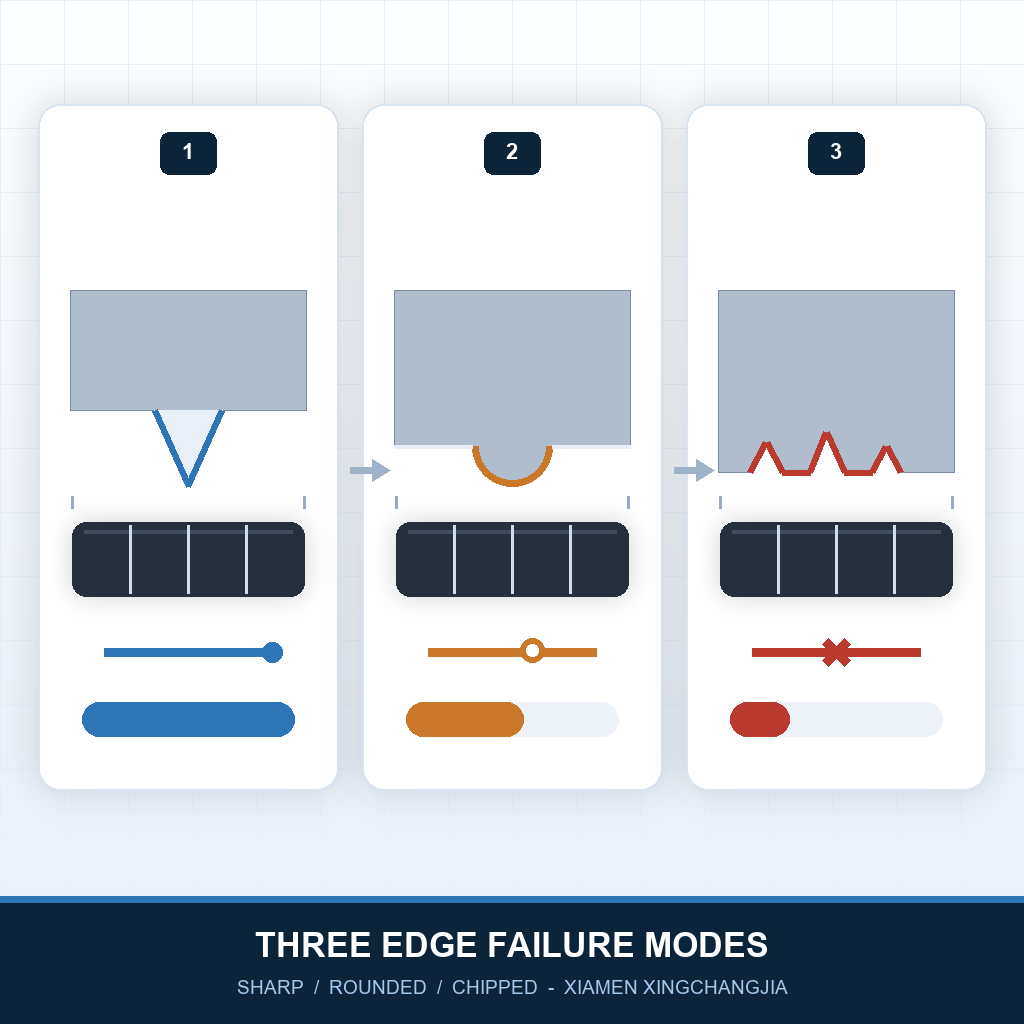
Three edge failure modes: rounding, chipping, clearance
What Does a Blade Change Cost Per 1,000 Meters?
Typically 0.9–1.8 USD per 1,000 m of cut edge on a gasket cutter, and the blade is the smallest line in that figure. A 0.35 mm carbide disc costs 18–35 USD, but 20–40 min of changeover plus 2–5 m of first-article scrap usually cost more. Since downtime dominates, batch changes into a planned window rather than reacting to each symptom, and lock out and tag out the machine before the guard comes off.
When Is Regrinding Better Than Replacing?
Regrind shear knives, be cautious with thin carbide discs, and never regrind white steel in-house. The limit is not the edge, it is the geometry the machine was set up around.
- Carbide discs (0.35 mm): two to three regrinds at most. Below roughly 0.28 mm the flanges stop holding the disc flat and cut width begins to wander.
- Bevel shear knives (0–20 mm): four to six regrinds are normal, provided the original bevel angle is restored. Change the angle and the shear force changes with it.
- White steel knives on the weight cutter: replace rather than regrind. The 550 mm cutting width and the pick-and-place cycle depend on a flat, unwarped edge.
Keep a blade log, not a blade box
Tag every reground blade with its measured thickness and the wear units it has already consumed. A disc at 0.30 mm does not get the same interval as a new one.
Conclusion: A Schedule You Can Defend
A schedule is a data habit, not a table in a manual. Once cut-edge meters and compound factors are logged, the interval sets itself.
Run the five steps for one month, then compare the result with the ranges above. If your life lands far outside them, the cause is usually clearance or feed rather than the blade. Send us the cut sample, the compound code and your current interval, and we will tell you which wear mode you are seeing.
Related Equipment Information
• Rubber cutting machine range overview — the full platform these blade specifications come from.
• XCJ-QGJ2-180# rubber gasket cutting machine — carbide disc cutter with ±0.05 mm accuracy and 240 cuts/min.
• CNC rubber strip cutting machine — bevel shear knife, 600/800/1000 mm worktables, 0–20 mm thickness.
• Fully automatic silicone cutting machine — 550 mm blade, 0–120 knives per minute.
• XCJ-A600 automatic weight cutting machine — white steel knife, 550 mm actual cut width.
Frequently Asked Questions: Blade Replacement
How often should I replace the blade on a rubber cutting machine?
Can carbide blades be reground instead of replaced?
Does cutting speed shorten blade life?
Why does one shift wear blades faster than another?
How can I spot a dull blade before parts go out of tolerance?
Do silicone and EPDM blades last the same number of cuts?
Xiamen Xingchangjia Non-Standard Automation Equipment Co., Ltd.
Floor1, Building 13, Huli Industrial Park, Meixidao, Tongan, Xiamen China
Email: info@xcjrubber.com | Website: www.xmxcjrubber.com
Published: November 2026 | Last verified: November 2026
Post time: Nov-10-2026